Things to Do in Dambulla
1. Visit the Dambulla Cave Temple
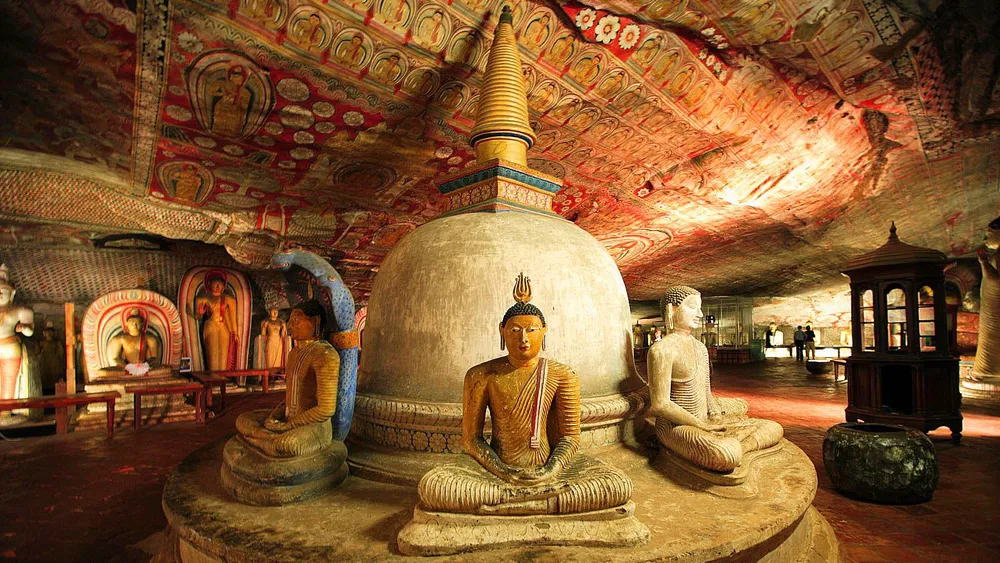
Dambulla Cave Temple is unarguably the most famous historic attraction in Dambulla. A UNESCO World Heritage Site, the monastery is home to the best-preserved cave complex in Sri Lanka.
The cavern temple network includes more than 80 documented caves, with the principal shrines distributed across five main caves that visitors can explore. Inside these sanctuaries, you will find ancient murals and statues depicting the Lord Buddha, kings, and deities. The painted murals cover a vast area of over 2,100 square meters. The cave temple is also considered one of the key pillars of the Cultural Triangle in Sri Lanka.
2. Rural Village Visits Around Dambulla
One of the best ways to discover authentic Sri Lankan rural life is by visiting the agrarian villages surrounding Dambulla and nearby Sigiriya. These countryside communities preserve traditional agricultural practices and village customs. Typical experiences include home-cooked traditional meals, authentic cooking demonstrations, visits to chena (slash-and-burn) farmlands, scenic catamaran canoe rides across village reservoirs, and quiet bird-watching walks.
3. Hiking the Rose Quartz Mountain (Jathika Namal Uyana)
Located approximately 15 km from Dambulla, the Rose Quartz Mountain is recognized as the largest rose quartz mountain range in South Asia. Mining is strictly prohibited here, as the geological deposit lies within the protected Jathika Namal Uyana nature sanctuary. Surrounding the quartz peaks is Sri Lanka’s largest natural ironwood forest (Mesua ferrea). Scattered within this tranquil forest are the archaeological ruins of a 3rd-century Buddhist monastery, where ancient texts record that convicts were granted sanctuary on condition of planting ironwood saplings.
4. Visiting Popham’s Arboretum
Popham’s Arboretum is the only dry-zone arboretum in Sri Lanka. Founded in 1963 by Sam Popham, an English naturalist and former naval officer, the sanctuary was created to restore degraded scrub jungle into natural dry-zone forest. Today it is managed by Ruk Rakaganno (The Tree Society of Sri Lanka). The arboretum features shaded nature trails lined with native semi-evergreen monsoon trees, excellent daytime birdwatching, and guided night walks renowned for sightings of the rare grey slender loris.
5. Visiting the Ibbankatuwa Megalithic Burial Site
The Ibbankatuwa Megalithic Burial Site is one of the most significant prehistoric archaeological sites excavated in Sri Lanka, dating between 700 BCE and 450 BCE. The mortuary complex spans several hectares and contains over 40 clusters of cist tombs constructed from massive unhewn stone slabs. Excavations have revealed clay funerary urns, copper and iron artifacts, beads, necklaces, and imported gemstones, proving extensive pre-historic settlement and regional maritime trade.
6. Bullock Cart Rides in the Countryside
Traditional bullock carts were historically the primary mode of overland transport across rural Sri Lankan villages. In the quiet farmlands around Dambulla and Sigiriya, travelers can experience a leisurely cart ride through village gravel lanes, paddy fields, and forest margins to gain a nostalgic glimpse of old-world transport.
7. Visit the Dambulla Museum of Wall Paintings
The Dambulla Museum of Wall Paintings, situated near the base of the rock temple, offers a focused overview of Sri Lanka’s ancient artistic legacy. The museum showcases meticulous replicas and documentation of murals spanning ancient cave rock art, Anuradhapura and Polonnaruwa classical frescoes, and Kandyan-era temple paintings, illustrating the artistic evolution of Sri Lankan muralists through the centuries.
8. Watch a Match at Rangiri Dambulla International Cricket Stadium
Set against the scenic backdrop of the Dambulla reservoir, the Rangiri Dambulla International Cricket Stadium is one of the island’s premier international sports venues. Watching a day-night limited-overs match alongside enthusiastic local supporters provides a memorable cultural experience for sports enthusiasts.