The ancient city of Polonnaruwa was the second capital of the island nation. Today, it is recognized as a UNESCO World Heritage Site and one of the finest archaeological destinations in South Asia. Spanning over 122 hectares of parkland on the banks of a vast ancient reservoir, the site preserves the country’s most impressive medieval artifacts, royal quarters, and monumental ruins.
The site houses the remains of an ancient Buddhist monastic university, known as Alahana Pirivena. Polonnaruwa is an essential stop for Buddhist pilgrims and cultural travelers alike, celebrated for its unique fusion of Anuradhapura traditions and South Indian Hindu architecture. In the past, the city gained prominence under South Indian Chola rulers before being reclaimed by Sinhalese kings during the eleventh century CE. Because the ancient inhabitants included both Buddhist and Hindu nobility, Buddhist monuments and Hindu shrines stand side by side throughout the complex. Though the kingdom was relatively short-lived—abandoned around 1300 CE in the face of shifting geopolitical tides—its liberal approach to art and architectural elegance laid the foundation for contemporary Sinhalese culture.
The Citadel of Polonnaruwa
The citadel of Polonnaruwa formed the fortified inner city that housed the royal palace complex of King Vijayabahu I and King Parakramabahu the Great. Enclosed within a massive brick rampart whose foundations remain preserved in a restored state, the citadel served as both the administrative center and the private sanctuary of the monarch. Several remarkable structures survive within this royal precinct.
Palace of King Parakramabahu (Vijayantha Prasada)
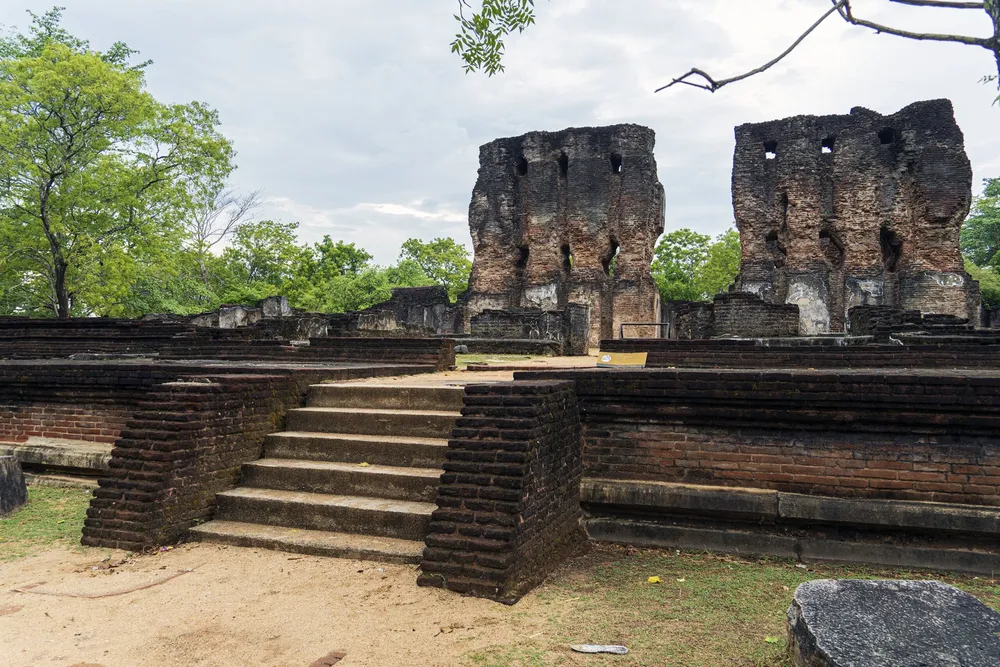
The Palace of King Parakramabahu is one of the most imposing ruins at Polonnaruwa. King Parakramabahu was the most powerful ruler of the Polonnaruwa era. He managed to win a civil war, reorganize Buddhist education, construct a massive reservoir, build an ocean-going navy, and sack coastal cities around the Bay of Bengal. He was a great patron of art, and most ruins in the archaeological complex were constructed with his funding in the twelfth century CE. Later kings of Polonnaruwa continually idolized him.
His palace was originally a seven-story royal pavilion known as Vijayantha Prasada. The lower three floors were built with massive brick walls, while the upper four levels formed an elaborate timber superstructure. Today, the soaring brick walls and structural recesses for the vertical wooden beams that once supported the upper floors remain clearly visible. The heavy stone staircase leading to the upper chambers remains intact, and patches of the original lime plaster still adhere to the masonry in several places.
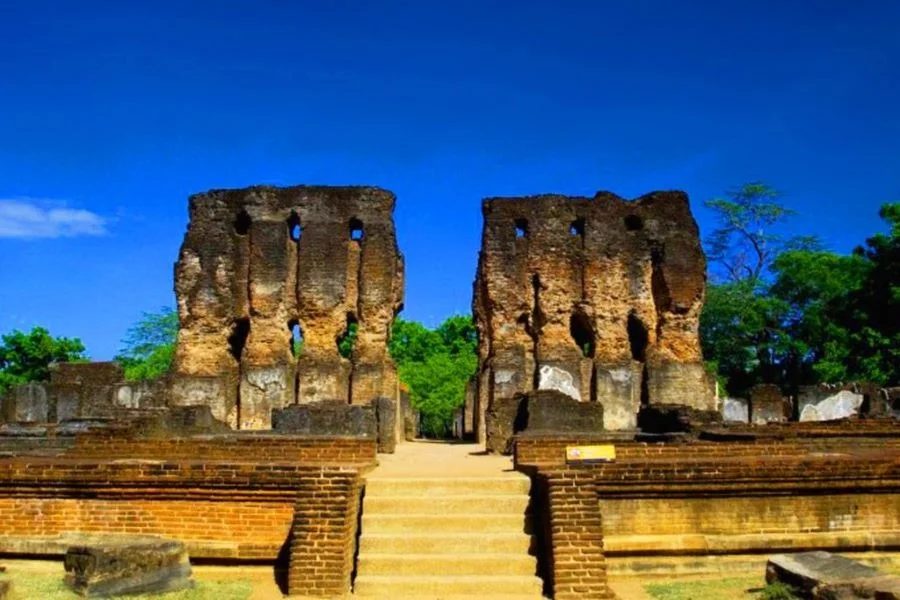 The towering brick ruins of the Royal Palace of King Parakramabahu (Vijayantha Prasada), once a seven-story royal citadel.
Council Chamber of King Parakramabahu
Positioned east of the royal palace, the King’s Council Chamber was the formal hall where state policies were decided and the city of Polonnaruwa was planned. The chamber is believed to have been constructed on the foundations of an earlier royal residence. The perimeter stone platform features intricately carved friezes showing tiers of marching elephants, lions, galloping horses, and mythical creatures.
The entrance represents a textbook example of classical Sinhalese stonework. A flight of stone steps flanked by delicately carved balustrades and two guardian lion statues greets visitors at the doorway. Inside the chamber, rows of carved stone pillars show evidence of the sockets that once supported a slanting timber roof.
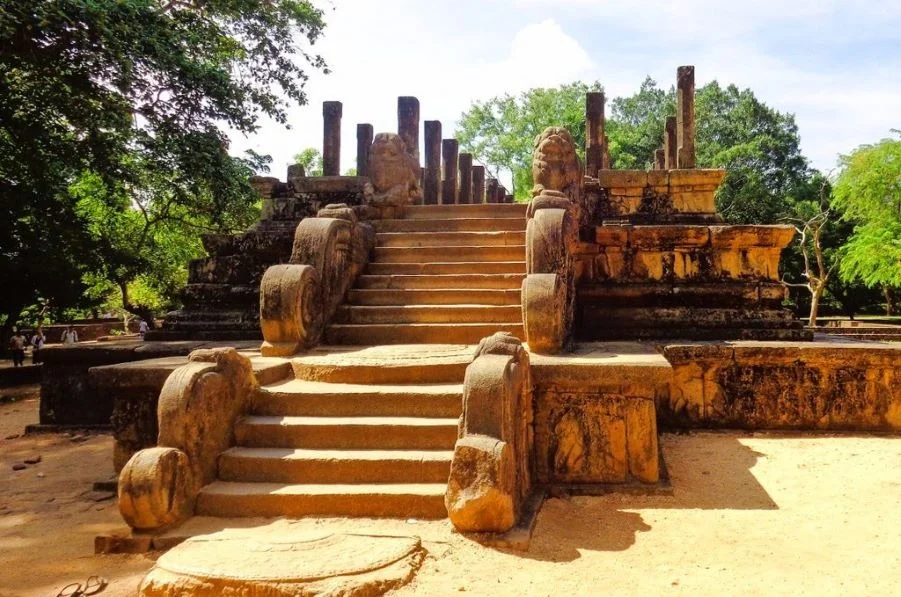 The Council Chamber of King Parakramabahu, featuring tiered stone friezes of marching elephants, lions, and guardian lion entrance sculptures.
Royal Bath (Kumara Pokuna)
Situated just outside the palace ramparts, the royal bath known as Kumara Pokuna is a prime example of ancient Polonnaruwa’s sophisticated water engineering. Underground conduits drew clean water directly from the nearby canal to feed carved stone spouts that poured into the pool. An outlet regulated by a stone sluice slab drained used water away. A stone resting seat stands beside the pool, accompanied by the foundations of royal changing rooms a short distance away.
The Sacred Quadrangle (Dalada Maluwa)
The Sacred Quadrangle is the centerpiece of the Polonnaruwa archaeological complex. Known historically as the Dalada Maluwa, this elevated square terrace served as the consecrated sanctuary where the Sacred Tooth Relic of the Buddha was enshrined during the medieval era. Visitors enter the precinct via a flight of stone stairs leading through the remains of an ancient gatehouse, arriving at a concentrated gathering of sacred architecture.
Vatadage (Circular Relic House)
The Vatadage is one of the most celebrated stone structures on the island. Serving as a circular relic house, it displays an exceptional standard of stonemasonry. Two tiers of stone terraces lead up to the central shrine, reached through four cardinal entrances adorned with ornate guard stones, moonstones, makara balustrades, and carved stone steps.
Within the circular inner sanctum, four seated Buddha statues face the four cardinal directions, seated around a small brick stupa where the Sacred Tooth Relic was once venerated. Remnants of concentric rows of stone pillars that once upheld a conical wooden roof still stand around the circular perimeter.
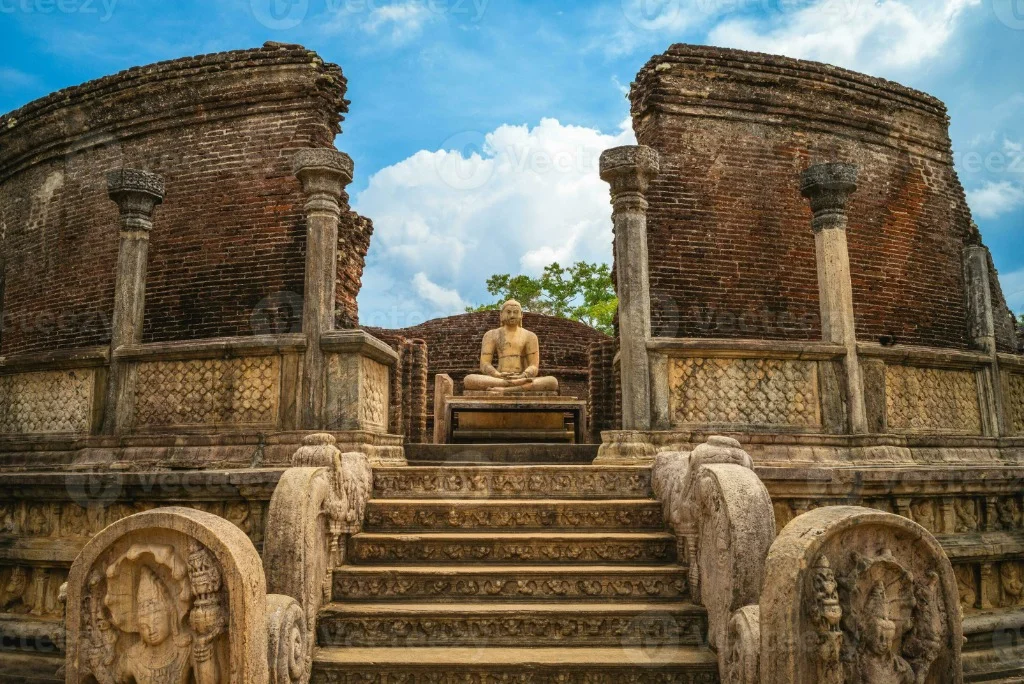 The Vatadage circular relic house, displaying exquisite guardstones, moonstones, and a serene seated Buddha statue facing the cardinal directions.
Thuparama Image House
Thuparama is the oldest surviving image house in Polonnaruwa, dating back to the eleventh century CE. Constructed of solid brickwork with walls several feet thick, this vaulted shrine retains its original corbelled roof. Crystalline limestone Buddha statues sit in the deepest part of the image house, reflecting ambient sunlight that enters through the doorway. The immense brick walls maintain a cool temperature within the chamber, and a narrow stone staircase built directly into the wall once allowed access to the roof.
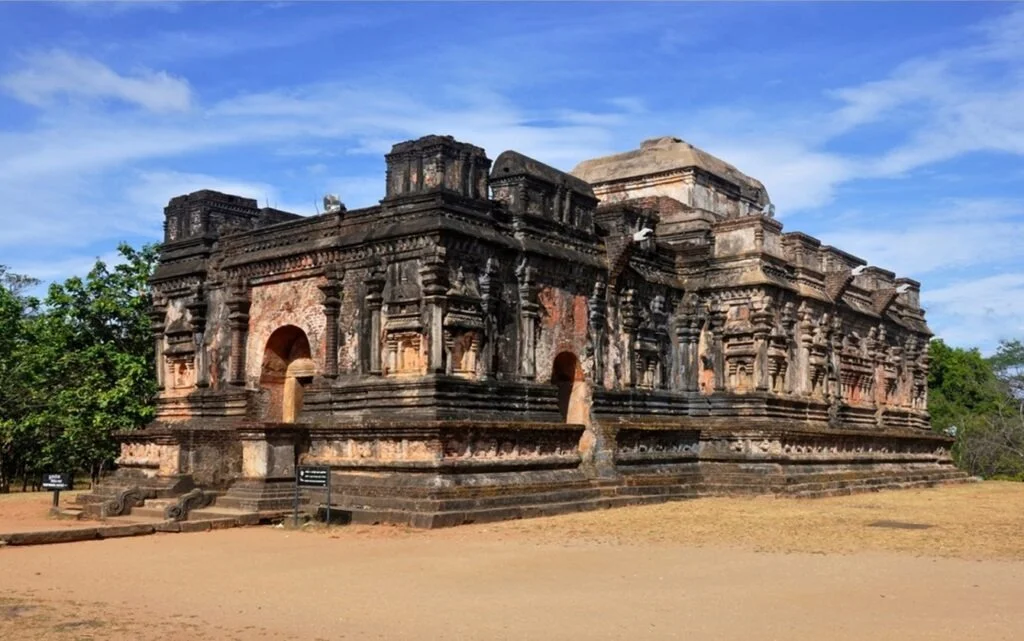 The vaulted brick exterior of Thuparama Image House, the oldest and best-preserved gedige shrine in Polonnaruwa.
Nissanka Latha Mandapaya (Lotus Pavilion)
Commissioned by King Nissankamalla, the Nissanka Latha Mandapaya is a distinctive masterpiece of ancient stone carving. The pavilion features stone pillars shaped like graceful lotus stalks bending gently upward to terminate in blooming lotus capitals. These delicate columns supported an open canopy, surrounded by a carved stone fence made to resemble a wooden trellis. An ancient rock inscription beside the pavilion records that King Nissankamalla used this pavilion to listen to the chanting of Buddhist pirith stanzas.
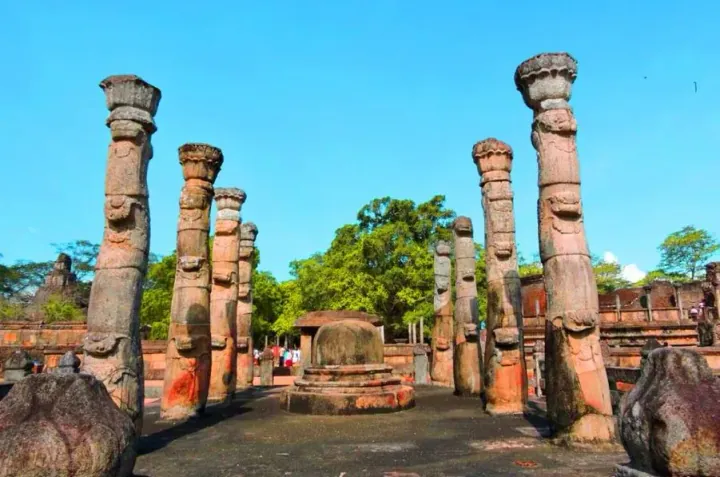 Nissanka Latha Mandapaya, renowned for its unique sinuous stone columns carved in the likeness of swaying lotus stalks.
Shiva Devale No. 1 and No. 2
The city of Polonnaruwa experienced substantial cultural influence from South Indian Chola rulers during periods of invasion and dynastic intermarriage. Around fourteen Hindu temples were excavated within the archaeological site, standing in harmony alongside Buddhist shrines. Shiva Devale No. 2 is constructed of precision-interlocking stone blocks without mortar, making it the oldest standing building in the entire Polonnaruwa complex. Shiva Devale No. 1, located within the quadrangle precinct, displays similarly refined stone carving inspired by classical Chola temple design.
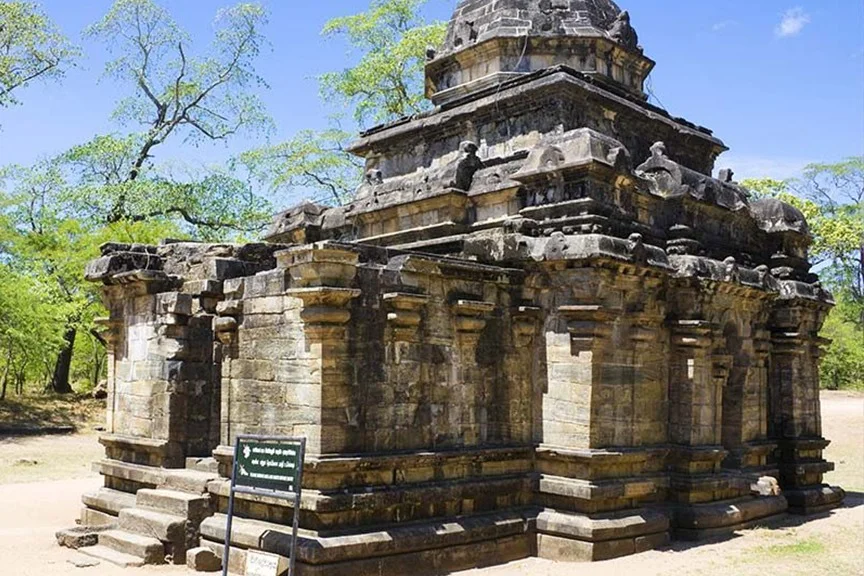 Shiva Devale No. 2, an ancient precision-interlocking stone Hindu temple constructed during the Chola period without mortar.
The Rock Temple of Gal Viharaya (Uttararama)
Gal Viharaya is one of the most revered cultural landmarks in Asia. The four monumental Buddha statues of Gal Viharaya represent the pinnacle of ancient stone sculpture on the island. The site was originally named Uttararama, meaning the Northern Monastery, and was commissioned by King Parakramabahu I in the twelfth century CE.
All four statues were carved directly from a single massive granite rock face, producing an unforgettable visual impact. The stonemasons achieved an extraordinary level of realism, rendering fluid robes that drape naturally over the body, subtle indentations beneath the head on stone pillows, and serene facial expressions that convey deep peace.
The Four Granite Sculptures
The complex begins with a seated Samadhi Buddha sitting in profound meditation atop a carved lotus throne against an ornate stone backrest. Beside it lies the Vidyadhara Guha, a small cave carved directly into the rock face containing a seated Buddha flanked by divine attendants, with remnants of ancient wall murals on the interior ceiling.
To the right stands the colossal seven-meter-tall Standing Buddha, known as the Maha Karuna statue, with arms folded across the chest in a rare gesture traditionally interpreted as an expression of universal sorrow and boundless compassion. Concluding the line of sculptures is the magnificent fourteen-meter Reclining Buddha, depicting the Parinirvana or final passing of the Buddha. The craftsmanship is evident in the gentle depression of the pillow beneath the head and the slightly withdrawn position of the upper foot, signifying liberation from worldly existence.
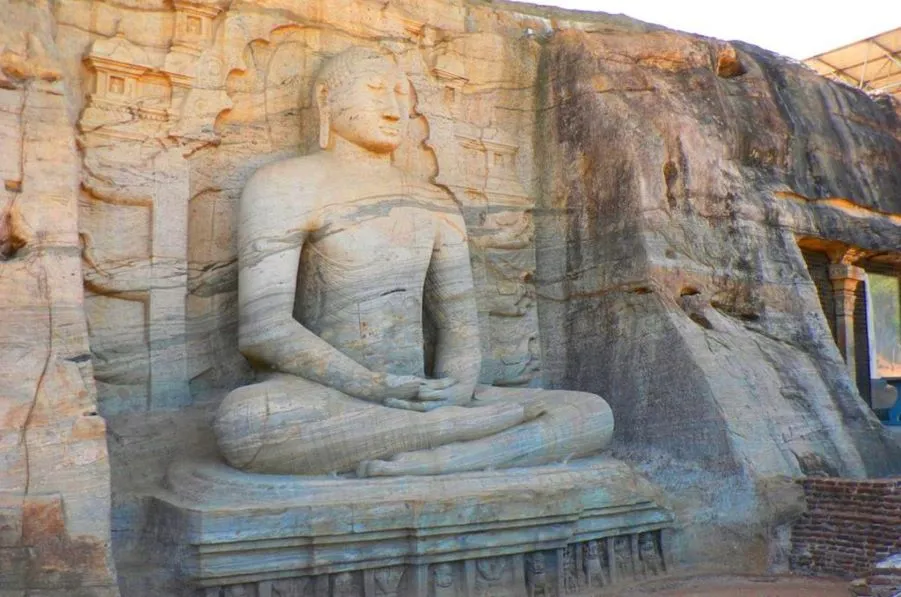 The colossal rock-carved Buddha statues of Gal Viharaya, masterfully sculpted from a single massive granite rock face.
Parakrama Samudra and Surrounding Monuments
The Parakrama Samudra is an immense twelfth-century reservoir named after King Parakramabahu I, who oversaw its construction. Covering approximately twenty-six square kilometers, the reservoir was engineered by connecting three older reservoirs that dated back to the third century CE. At the time of completion, it was the largest artificial lake on the island, earning the title “The Sea of Parakrama.” Several significant historical sites border the banks of this inland sea.
Statue of Parakramabahu or Sage Pulasthi
Facing the vast waters of the reservoir stands a colossal high-relief statue carved into an isolated rock boulder. There has long been scholarly debate regarding the identity of the figure. Traditional folklore identifies it as King Parakramabahu holding the yoke of sovereign authority. However, the figure wears simple ascetic garb, has a long beard, and carries an ola-leaf manuscript, leading historians to suggest it portrays the mythical Sage Pulasthi. The historic name Polonnaruwa is itself derived from Pulasthipura, meaning the city of Pulasthi.
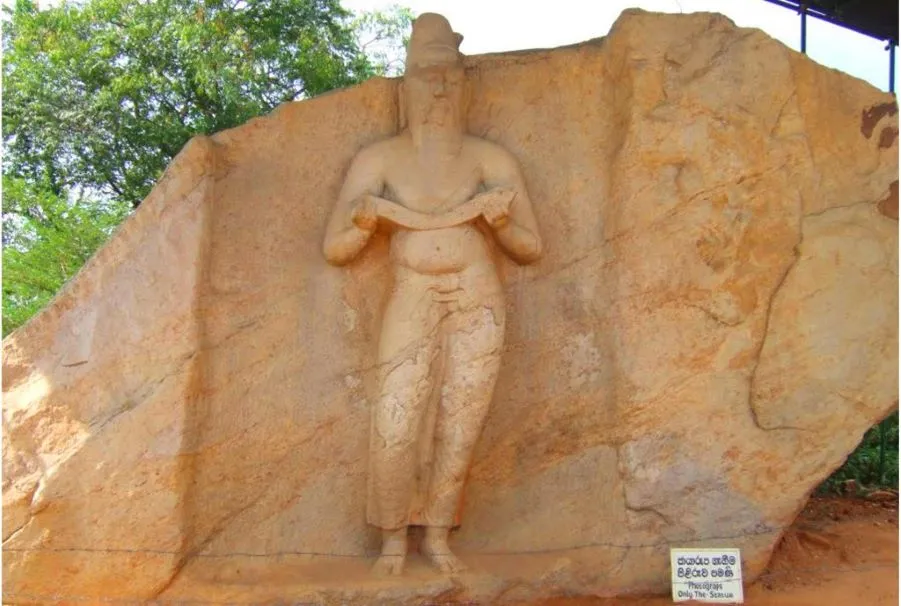 The vast waters of Parakrama Samudra, the colossal ancient reservoir bordering the colossal rock statue of King Parakramabahu or Sage Pulasthi.
Pothgul Vehera Complex
Situated south of the rock statue, Pothgul Vehera is traditionally identified as an ancient monastic library. The complex features a central circular brick rotunda situated on four stepped terraces, surrounded by the foundations of monk residences and small stupas. The unusual layout and hollow interior suggest the rotunda may also have served as a sacred reading chamber or shrine for monastic texts.
King Nissankamalla Palace Complex (Deepa Uyana)
Located on an island-like promontory of the reservoir called Deepa Uyana (Island Park), the palace remains of King Nissankamalla offer a glimpse into royal leisure. King Nissankamalla was an ambitious ruler who commissioned numerous monuments across the kingdom. His palace complex preserves a council chamber decorated with carved lion pillars, an inscribed stone lion throne, and a tiered stone bathhouse.
Polonnaruwa Archaeological Museum
The Polonnaruwa Archaeological Museum is an essential starting point for any visit to the ancient city. Designed under the direction of Professor Leelananda Prematilleke, former archaeological director of Polonnaruwa, the museum features scale architectural models, restored bronze deities, ancient medical instruments, and historical exhibits explaining the city’s evolution. The museum is also the official location where tickets for the archaeological park are issued.
Cycling in Polonnaruwa: Practical Guide
Cycling in Polonnaruwa is the ideal way to explore the archaeological ruins. Taking two wheels removes the hurry from your visit and allows ample time to enjoy your favorite places without fatigue. Rushing through this ancient capital by car can make the experience far less charming, whereas cycling across the 122-hectare site lets you move easily between the hundreds of monuments scattered under shaded trees, manicured lawns, and paved park roads. Cyclist guides are readily available at the park entrance for travelers who want guided interpretation along the trails.
Cycling through the ancient park offers a sense of open freedom, letting you take in the gentle breeze from the reservoir, pause for photography at uncrowded viewpoints, and discover secluded forest shrines that vehicle tours usually miss.
A few practical tips will help you make the most of your cycling tour. While vehicles are permitted inside the park grounds and dedicated cycle lanes do not exist, vehicle speeds are strictly regulated and drivers are generally careful. Midday heat in the dry zone can be intense, so carry a generous water bottle and wear light, breathable clothing. Because entrance tickets are valid only for a single day, planning your cycling route from the museum northward toward Gal Viharaya helps maximize your time.
Make sure your clothing covers both knees and shoulders, as modest dress is strictly enforced across all Buddhist and Hindu shrines. You will be required to remove footwear and hats before walking onto ancient granite pavements and sand courtyards, which can become very hot under the midday sun; bringing a pair of thick socks makes walking across sunlit stone far more comfortable.
Planning Your Visit to Polonnaruwa
Polonnaruwa is a core destination in the Cultural Triangle, easily combined with Sigiriya Rock Fortress and Dambulla Cave Temple. The archaeological reserve and museum are open daily from 7:00 AM to 5:30 PM.
Our tailored travel itineraries, including private cultural tours and heritage expeditions, provide seamless vehicle transfers, professional chauffeur-guides, and curated hotel stays. To plan your visit through Polonnaruwa and the surrounding cultural landmarks, contact our travel specialists.
Frequently Asked Questions
What is the entrance fee for the Polonnaruwa Ancient City?
The Central Cultural Fund (CCF) round ticket for international visitors costs approximately USD $30 for adults and USD $15 for children aged 6 to 12 as well as SAARC passport holders. Tickets must be purchased in person at the Polonnaruwa Archaeological Museum before entering the ancient city ruins, as there are no ticket booths at the individual monument gates.
How much time should I allocate to explore Polonnaruwa?
Most travelers spend between three to five hours exploring the main highlights of the ancient city, including the Royal Citadel, the Sacred Quadrangle, Gal Viharaya, and the Parakrama Samudra. Exploring by bicycle generally takes four to five hours, while traveling with a private car and driver takes around three to four hours.
Is cycling suitable for everyone in Polonnaruwa?
Cycling is suitable for most fitness levels because the terrain across the archaeological park is flat and paved with good paths. Bicycles of various sizes can be rented near the archaeological museum or through your tour driver for a small daily fee. For travelers visiting during the hottest midday hours or those traveling with small children, an air-conditioned private vehicle provides a more comfortable alternative.
What is the dress code for visiting the ruins in Polonnaruwa?
Visitors must wear attire that covers both shoulders and knees when entering any religious monument in Polonnaruwa, including the Sacred Quadrangle, Vatadage, and Gal Viharaya. Transparent or tight-fitting garments are not permitted. Shoes and headwear must be removed before stepping onto temple terraces and around sacred Buddha statues.
What photography rules should I follow at Gal Viharaya and other shrines?
Photography is permitted throughout the archaeological complex, but posing with your back turned directly toward a Buddha statue is strictly forbidden and considered deeply disrespectful. Selfie sticks should be used with care, and flashes should not be used inside ancient image houses containing delicate limestone or plastered surfaces.
Can Polonnaruwa be combined with Sigiriya or Minneriya on the same day?
Yes, Polonnaruwa is located roughly one hour's drive from Sigiriya and Habarana. A popular day tour itinerary involves exploring the ancient ruins of Polonnaruwa in the morning, enjoying a traditional lunch, and continuing in the afternoon for an elephant gathering safari in Minneriya National Park or visiting the Sigiriya Rock Fortress in late afternoon light.