Dambulla Cave Temple, also revered as the Golden Temple of Dambulla, is a UNESCO World Heritage Site located in the central Matale District of Sri Lanka. Since its monastic beginnings in the first century BCE, this sacred cliffside sanctuary has provided shelter to thousands of meditating Buddhist monks. Today, the complex preserves the most extensive and best-preserved collection of Buddhist wall paintings and rock sculptures in South Asia, representing an uninterrupted tradition of religious art spanning more than two millennia.
Known historically as Swarna Giri Guha, meaning the “Golden Rock Caves,” the complex was repeatedly restored and expanded by successive royal dynasties to honor the Buddhist Sangha and provide merit for faithful pilgrims. The temple remains an active pilgrimage sanctuary where devotees offer fresh lotus blossoms and light coconut-oil lamps daily. Unlike the sprawling ruins of ancient capitals across the Cultural Triangle, Dambulla’s principal sanctums are conveniently gathered beneath a single monumental overhanging granite rock, perched 160 meters above the surrounding plains with panoramic views across the dry-zone forests.
History and Royal Patronage
The monastic history of Dambulla began in the first century BCE when King Valagamba (Vatta Gamini Abhaya) was driven from his royal seat in Anuradhapura by South Indian invaders. The exiled monarch sought refuge within the remote forested caves of Dambulla, protected by hermit monks for fourteen years. Upon regaining his throne, King Valagamba transformed his refuge into a magnificent rock monastery, carving living quarters and sanctums into the cliff.
Over subsequent centuries, later Sinhalese kings continued to embellish the caves. In the twelfth century CE, King Nissankamalla of Polonnaruwa gilded seventy-three Buddha statues with gold leaf and recorded his donations on a massive rock inscription near the entrance, officially earning the site its epithet “Rangiri Dambulla” (Golden Rock Dambulla). During the eighteenth century, King Kirti Sri Raja Singha of Kandy initiated extensive restoration work, commissioning vibrant ceiling murals and constructing the third major cave shrine in the distinctive Kandyan artistic tradition.
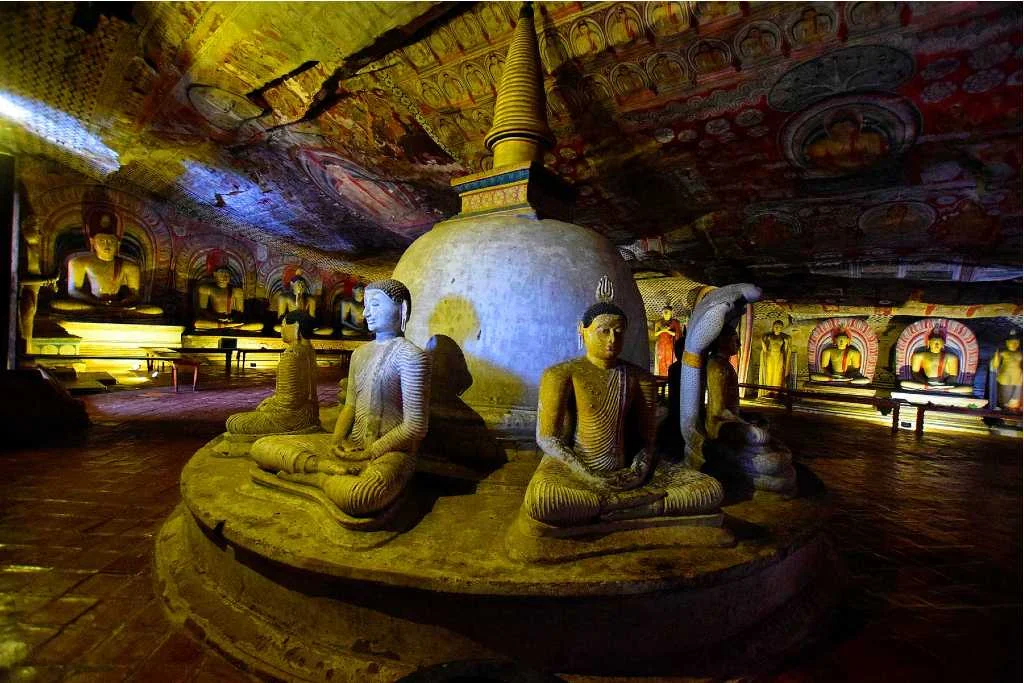
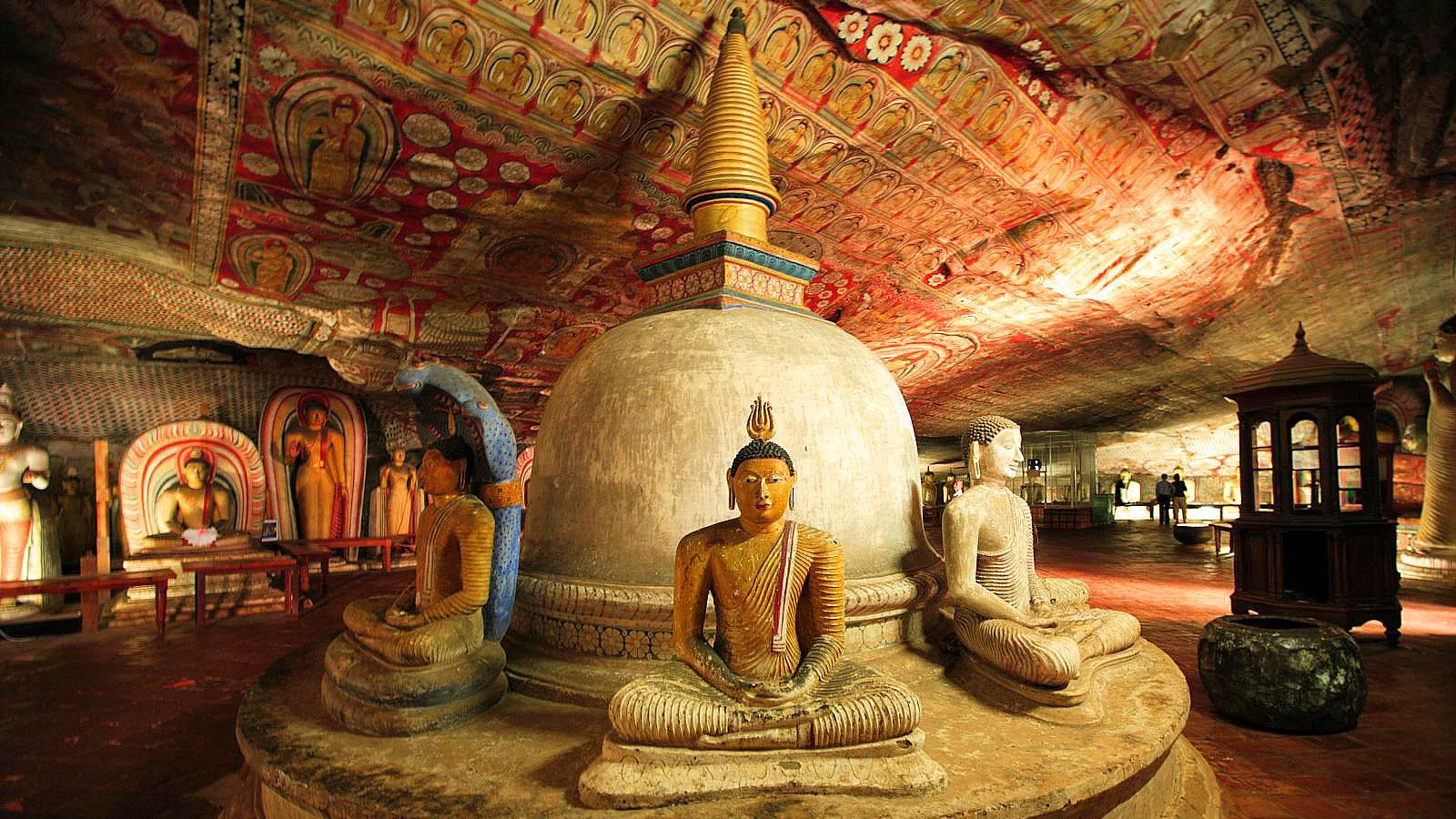
The five primary caves were carved out beneath the overhanging cliff and compartmentalized using thick brick masonry walls. Because none of the inner sanctums receive direct sunlight, the murals are shielded from natural weathering, preserving their extraordinary pigmentation across more than 2,100 square meters of rock ceiling and walls. More than 150 Buddha statues, accompanied by sculptures of patron kings and guardian deities, adorn the interior terraces.
The Five Sacred Cave Temples
Cave 1: Deva Raja Lena (Cave of the Divine King)
The first cave is traditionally known as Devaraja Lena, which translates to the Cave of the Divine King. A fine Brahmi inscription carved above the entrance records how the monastery was initially gifted to the Sangha by Gamani Tissa, identified by historians as King Valagamba.
The interior is dominated by a breathtaking fourteen-meter rock-cut statue of the reclining Buddha, carved directly out of the living granite cliff face. The sculpture portrays the final passing of the Buddha into Parinirvana, with delicate traces of ancient gilding and paint along the flowing folds of the robe. Standing respectfully beside the Buddha’s feet is a stone sculpture of his devoted disciple, Venerable Ananda. At the head of the reclining statue stands a shrine dedicated to God Vishnu, who according to ancient tradition assisted King Valagamba in establishing the sanctuary.
Cave 2: Maha Raja Lena (Cave of the Great Kings)
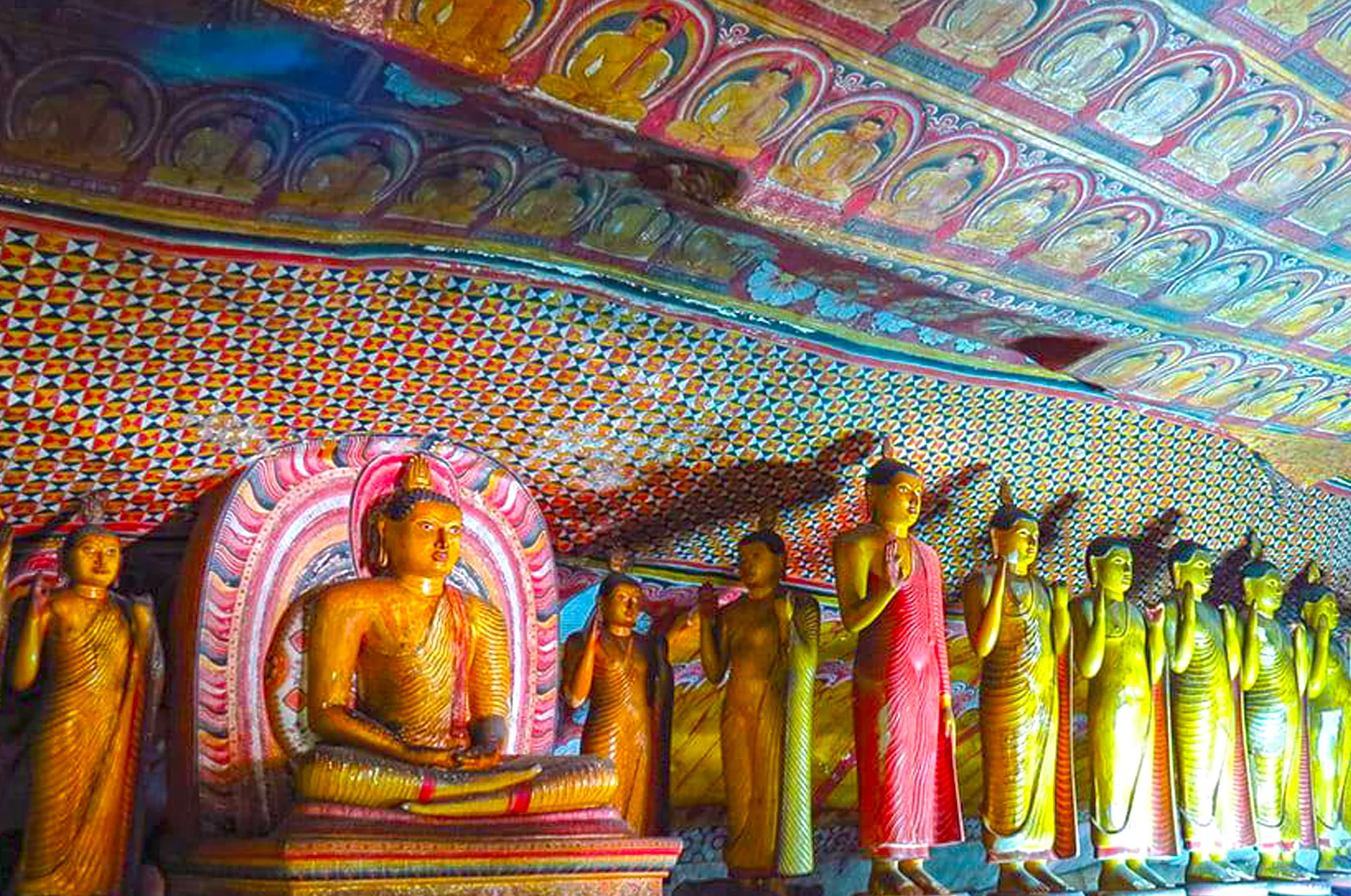
Maha Raja Lena is the largest, most magnificent, and architecturally complex cave in the entire Dambulla sanctuary. Measuring over fifty meters in length and seven meters in height, this grand hall contains approximately sixty statues and is enveloped in extraordinary tempera frescoes that completely blanket the walls and curved rock ceiling.
The primary centerpiece is a life-sized seated Buddha sculpture sheltered beneath an elaborately carved Makara Torana (dragon arch), flanked by statues of the aspirant Bodhisattvas Maitreya and Avalokiteshvara. Historical statues of King Valagamba and King Nissankamalla stand within the hall, honoring the two monarchs responsible for the cave’s initial construction and medieval gilding.
The ceiling frescoes are arranged in dynamic horizontal panels illustrating significant episodes from the life of the Buddha, including his birth, the temptation and defeat of the demon Mara, and the First Sermon at the deer park in Sarnath. Another series of murals chronicles the arrival of Prince Vijaya and the legendary triumph of King Dutugemunu. In the center of the cave, natural spring water drips continuously from a fissure in the rock ceiling, gathered in a consecrated vessel and reserved exclusively for sacred temple rituals.
Cave 3: Maha Aluth Viharaya (The Great New Temple)
Commissioned in the late eighteenth century by King Kirti Sri Raja Singha of Kandy, Maha Aluth Viharaya retains an immense sense of royal grandeur. This spacious cave represents the pinnacle of late Kandyan visual art, characterized by rich crimson and ochre hues, intricate floral patterns, and detailed narrative compositions.
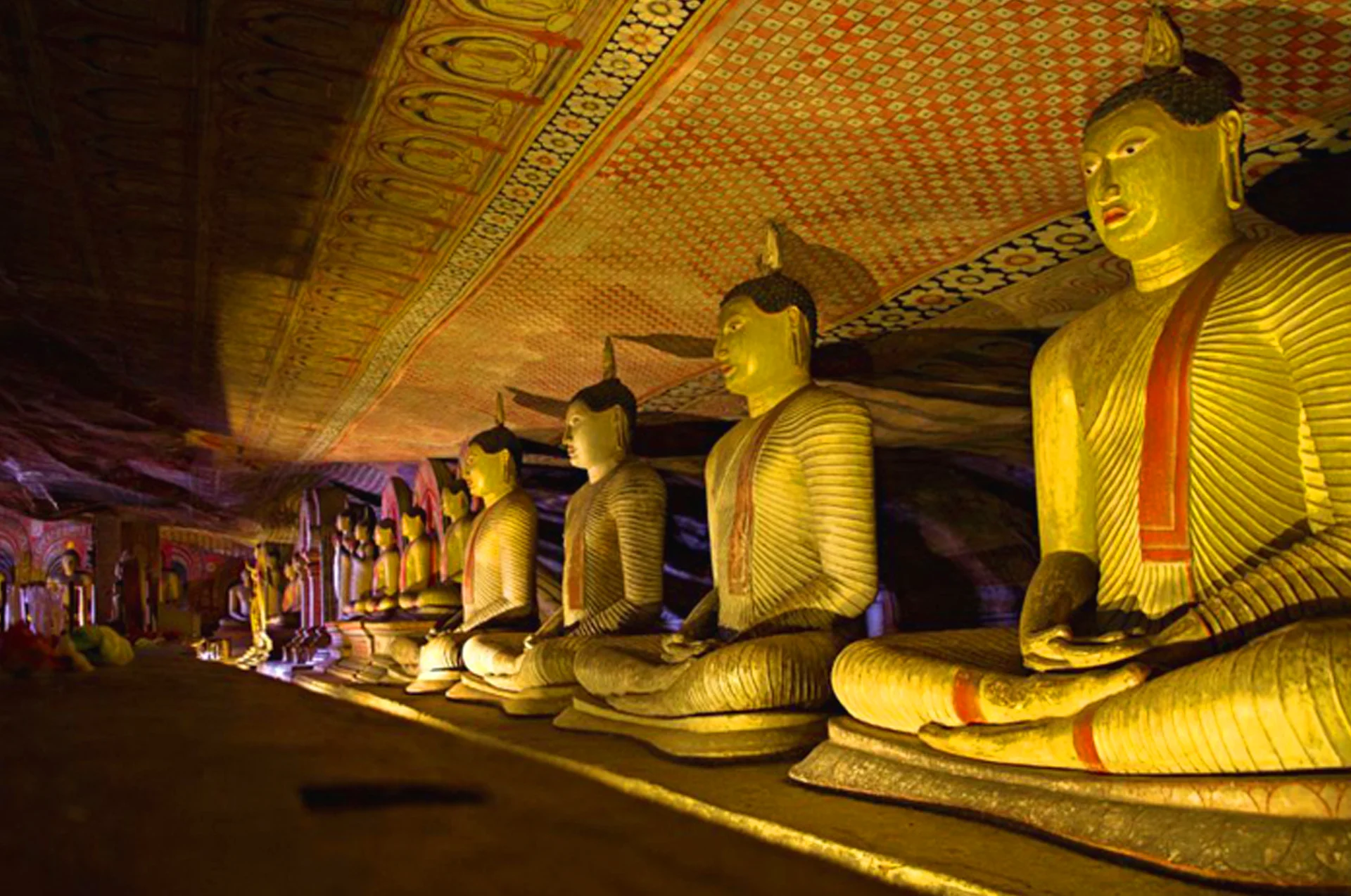
The cave houses over fifty statues, including a monumental nine-meter reclining Buddha carved out of the rock and numerous seated figures positioned in rows around the perimeter. Elaborate paintings on the rock face depict the future Buddha Maitreya and assemblies of enlightened monks. Near the entrance doorway stands a full-length painted statue of King Kirti Sri Raja Singha dressed in elaborate ceremonial Kandyan robes, commemorating his enduring patronage of the site.
Cave 4: Paccima Viharaya (The Western Temple)
Paccima Viharaya, meaning the Western Temple, was the westernmost cave prior to later eighteenth-century additions. While smaller than the first three sanctuaries, it features an intimate and serene spiritual atmosphere.
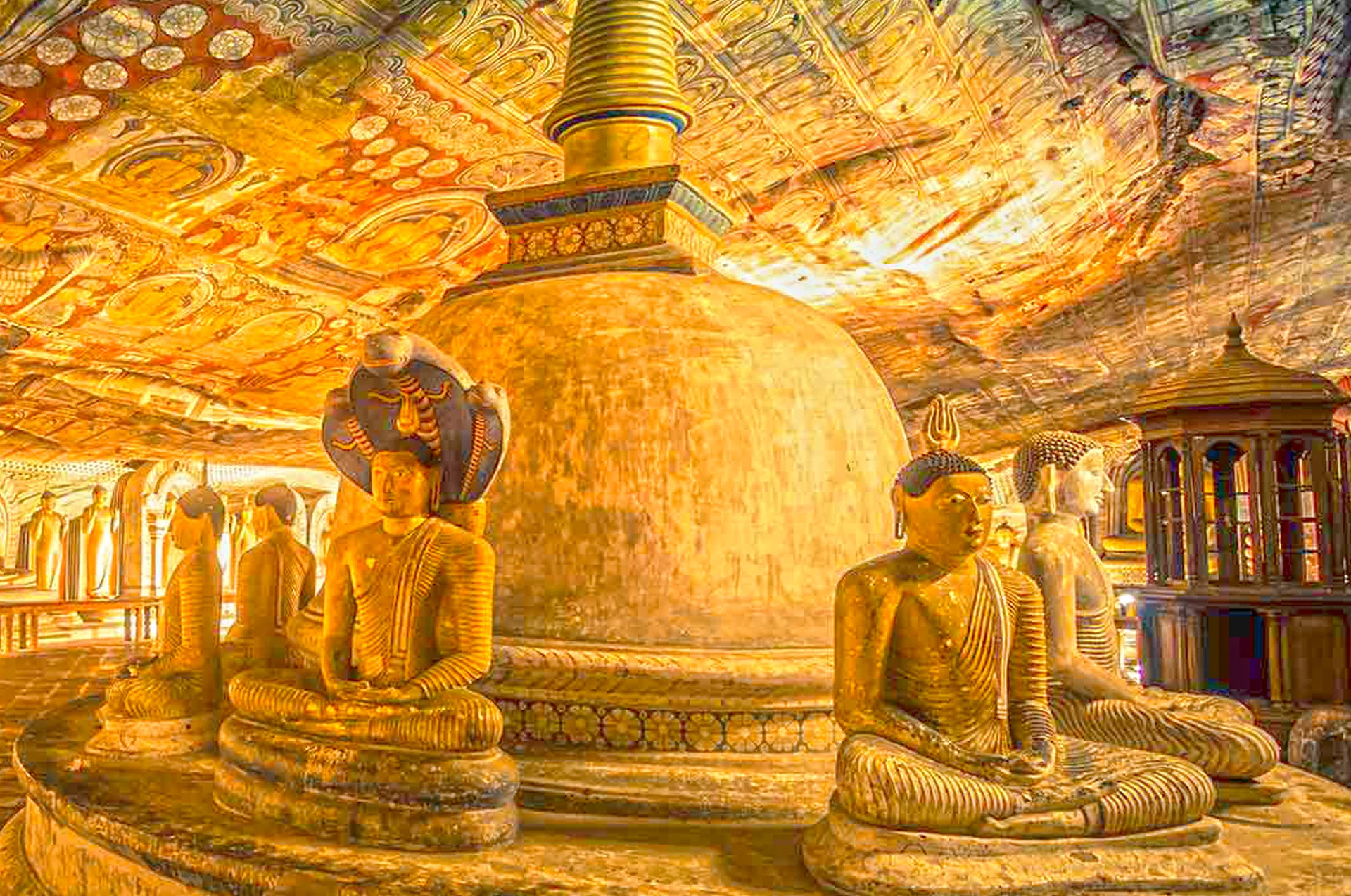
Multiple seated Buddha statues grace the room, centered around an ornate Makara Torana framing the main meditative image. In the middle of the cave stands a miniature brick stupa known as the Soma Chetiya. According to local religious tradition, this small stupa enshrines the sacred royal jewelry of Queen Somawathi, the consort of King Valagamba. Subtle restorations during the early twentieth century have preserved the vivid decorative scrollwork and celestial patterns adorning the ceiling.
Cave 5: Devana Aluth Viharaya (The Second New Temple)
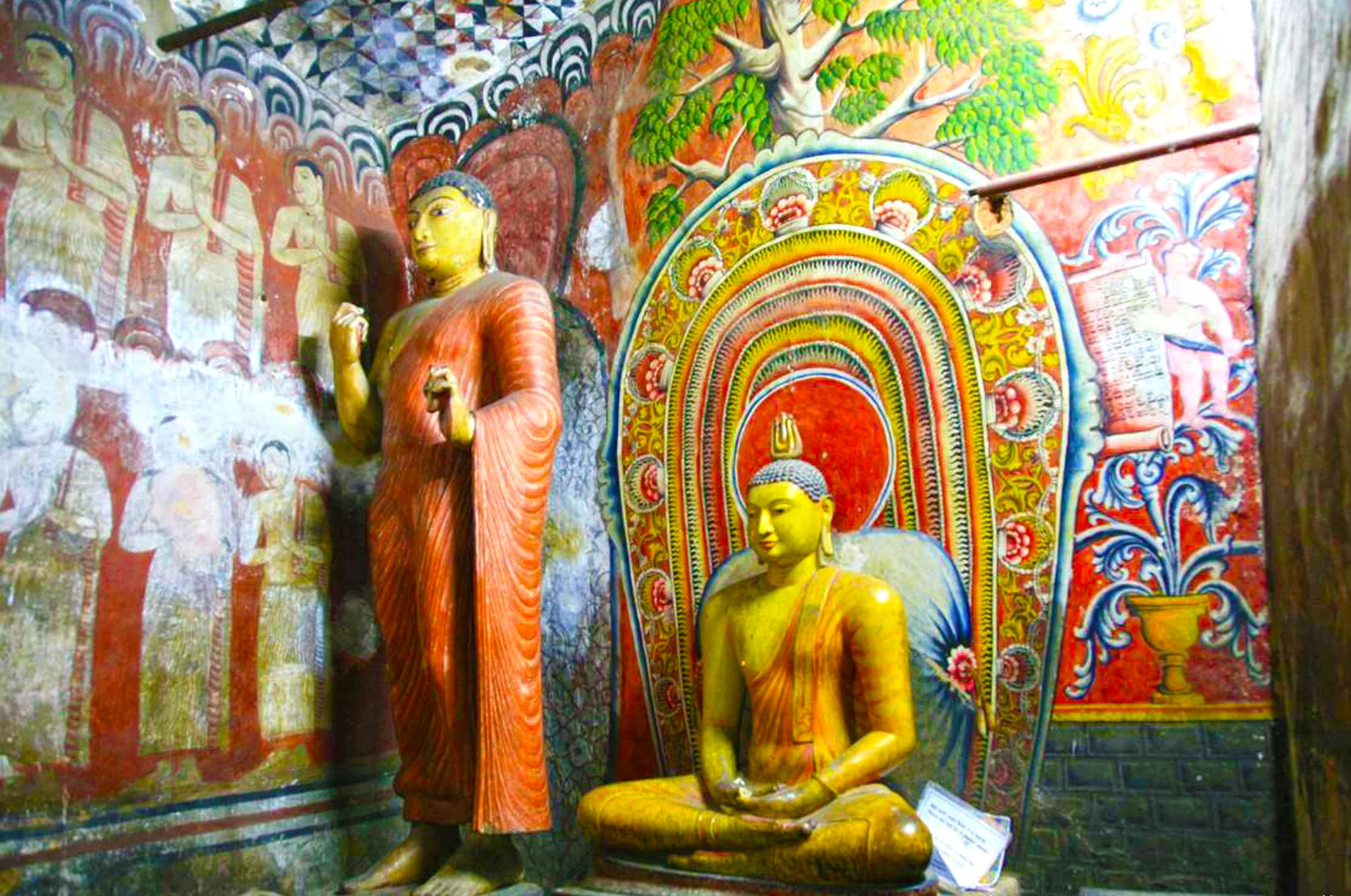
The smallest of the five sanctuaries is Devana Aluth Viharaya, or the Second New Temple. Originally utilized as a monastic storehouse, it was converted into a formal image shrine during the early twentieth century.
A large reclining Buddha occupies the central floor area, framed by vibrant wall murals illustrating Hindu and indigenous guardian deities that became integrated into Sri Lankan Buddhist tradition. Among these are depictions of God Vishnu, God Kataragama (Skanda), the local protective deity Devata Bandara, and noble devotees carrying fresh lotuses in veneration. This assembly of sacred figures vividly illustrates the harmonized spiritual beliefs of contemporary Sinhalese Buddhism.
Front Colonnade, Drip Ledge, and Courtyard
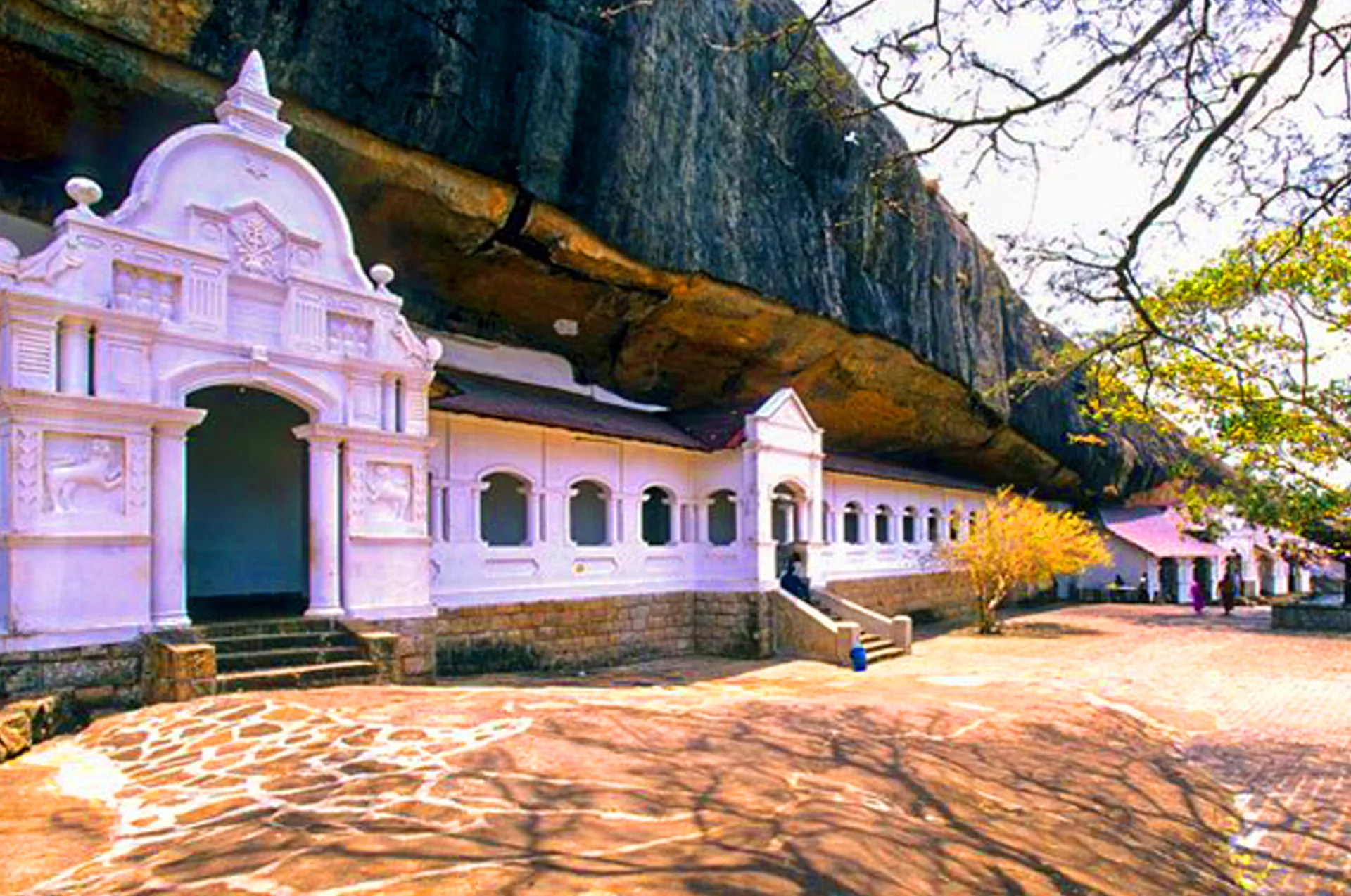
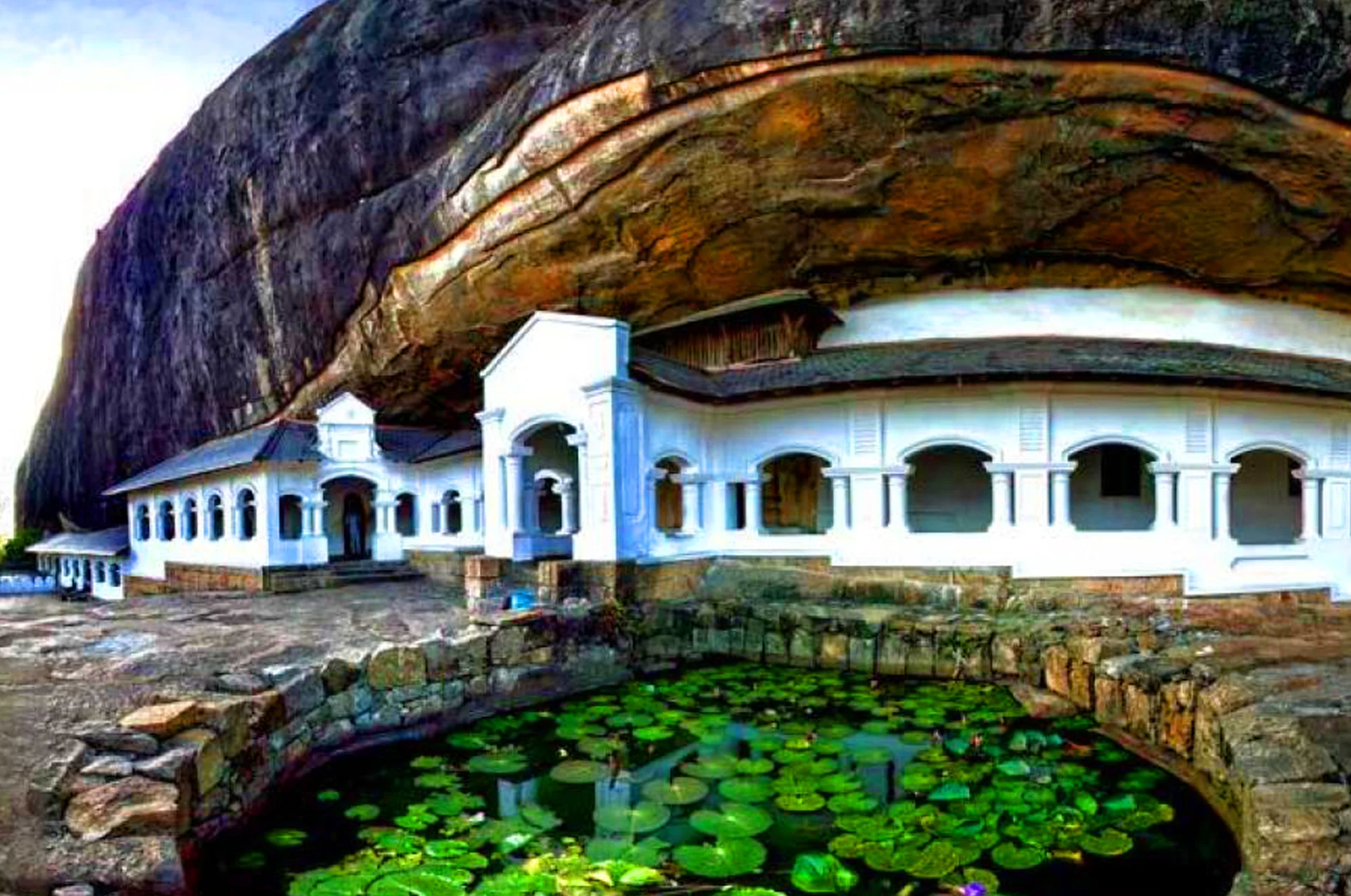
Access to all five cave shrines is granted through an elegant whitewashed colonnade constructed in the 1930s. Combining elements of British colonial veranda architecture with indigenous wooden eaves, this covered corridor protects the cave entrances from torrential tropical rainfall while creating a luminous transition between the outer courtyard and the dimly lit shrines.
High above the whitewashed entrance facade, an ancient rock-cut drip ledge (katarama) runs continuously along the cliff face. Chiseled into the rock by ancient craftsmen more than two thousand years ago, this groove redirects rainwater away from the cliff overhang, preventing moisture from seeping into the cave ceilings and destroying the delicate plaster beneath. Above the drip ledge, ancient Brahmi script remains clearly visible, authenticating the monastery’s origins in antiquity.
Outside the corridor lies an expansive granite courtyard offering spectacular panoramas across the forested horizon toward Sigiriya Rock Fortress. On the eastern side of the terrace stands a venerable Bodhi tree enclosed by stone railings, while a large rock inscription inscribed by King Nissankamalla near the western approach details the royal decree that transformed Dambulla into an enduring sanctuary of gold.
Planning Your Visit to Dambulla Cave Temple
Dambulla Cave Temple is open to visitors daily from 7:00 AM to 7:00 PM, with the ticket counter operating until 5:00 PM. Visiting early in the morning or during the late afternoon provides the most comfortable ascent, cooler temperatures on the stone courtyard, and soft natural lighting across the surrounding valley.
The ascent to the caves involves climbing a gradual stone stairway of approximately 300 to 360 wide steps carved into the hillside. The walk typically takes between 15 and 25 minutes at a relaxed pace, with multiple shaded resting landings along the path where travelers can pause to enjoy views of the surrounding countryside.
Our private itineraries across Sri Lanka, including custom cultural tours and Cultural Triangle expeditions, feature seamless private transfers, knowledgeable chauffeur-guides, and curated hotel stays. To plan your visit through Dambulla and neighboring heritage landmarks, contact our travel specialists.
Frequently Asked Questions
Where do I purchase tickets for the Dambulla Cave Temple?
Entrance tickets must be purchased at the official ticket counter located at the base of the rock, near the modern Golden Temple and museum entrance, before beginning your ascent. There is no ticket booth at the top of the rock, so be sure to secure your ticket before climbing the steps. The international visitor ticket costs approximately LKR 2,000 (around USD $10).
How difficult is the climb to Dambulla Cave Temple?
The climb consists of roughly 300 to 360 gently sloped stone steps and takes approximately 15 to 25 minutes. Most travelers of average fitness find the ascent very manageable. There are several shaded landing areas along the pathway where you can rest, hydrate, and take in scenic views of the plains.
What is the required dress code for visiting Dambulla Cave Temple?
Because Dambulla Cave Temple is an active Buddhist religious sanctuary, all visitors are required to dress modestly. Shoulders and knees must be completely covered for both men and women. Loose trousers, maxi skirts, or sarongs paired with sleeved tops are ideal. Transparent or revealing clothing is not permitted.
Do I have to remove my shoes when visiting the caves?
Yes, visitors must remove footwear and headwear before entering the sacred courtyard and cave entrances. A supervised shoe storage facility is available at the entrance gate for a small nominal fee. Because the stone courtyard can become hot under the midday sun, bringing a pair of thick socks will protect your feet while walking across the granite terrace.
Are photography and filming permitted inside the caves?
Photography is permitted inside the caves, but flash photography is strictly prohibited because sudden bright light damages the ancient pigments of the delicate ceiling murals. Posing for photos with your back turned directly toward a Buddha statue or posing alongside statues is strictly forbidden and considered disrespectful.
Can Dambulla Cave Temple be combined with Sigiriya on the same day?
Yes, Dambulla Cave Temple and Sigiriya Rock Fortress are located just 25 kilometers apart, which takes approximately 30 to 40 minutes by car. A classic Cultural Triangle itinerary pairs an early morning climb of Sigiriya Rock Fortress with a late afternoon visit to Dambulla Cave Temple, avoiding midday heat while experiencing two UNESCO World Heritage Sites in one day.