Nestled among mist-veiled hills in the Central Province, approximately 115 kilometers east of Colombo, Kandy—known historically as Maha Nuwara, meaning the “Great City”—is the spiritual and cultural heart of the island. Surrounded by the forested peaks of the Hanthana and Knuckles mountain ranges and embraced by the graceful curves of the Mahaweli River, Kandy sits at an altitude of approximately 500 meters (1,640 feet) above sea level. This elevated position blesses the city with a pleasantly cool climate that provides a welcome relief from the tropical heat of the coastal plains.
As the last royal capital of the ancient Sinhalese monarchy, Kandy defended its sovereignty through centuries of colonial pressure until it was finally annexed by the British Empire in 1815. Inscribed as a UNESCO World Heritage Site in 1988, this sacred sanctuary preserves centuries-old religious rituals, exquisite wood and stone architecture, traditional performing arts, and a tranquil lakeside rhythm that continues to enchant travelers from around the globe.
The Spiritual Heart: Temple of the Sacred Tooth Relic
The undisputed spiritual centerpiece of Kandy is the Temple of the Sacred Tooth Relic, locally revered as Sri Dalada Maligawa. Positioned within the former royal palace complex, the temple enshrines the left canine tooth relic of Gautama Buddha. In the nation’s history, the possession of this sacred relic was intimately tied to the legitimate right to rule, compelling ancient monarchs to protect and venerate it with utmost devotion.
The golden-roofed temple complex is framed by a tranquil water moat (Diyagawma) and surrounded by an ornate low wall carved with traditional cloud apertures (Walakulu Bamma). Visitors enter through the Maha Vahalkada gateway, crossing a stone footbridge and passing through a series of grand chambers decorated with painted wood ceilings, carved ivory tusks, and guardian stone reliefs.
At the center of the inner courtyard stands the two-story Vadahitina Maligawa (inner sanctum), where the Sacred Tooth Relic is preserved. The relic rests inside a succession of seven nested golden stupa-shaped caskets (karanduwa), each adorned with rare gemstones, diamonds, and rubies. While the tooth itself remains sheltered within its caskets, the shrine doors are opened to worshippers and travelers during the daily theva pooja services held at dawn, midday, and twilight, accompanied by the thunderous cadence of ceremonial drums (hewisi) and traditional wind instruments.
Adjoining the main temple are several significant royal and religious edifices. The royal audience hall (Magul Maduwa) features intricately carved wooden pillars constructed during the late Kandyan kingdom, where the historic Kandyan Convention was signed in 1815. Adjacent buildings house the National Museum of Kandy, exhibiting royal crowns, regalia, and ceremonial weapons, alongside the International Buddhist Museum, which illustrates the dissemination of Buddhist philosophy across Asian nations.
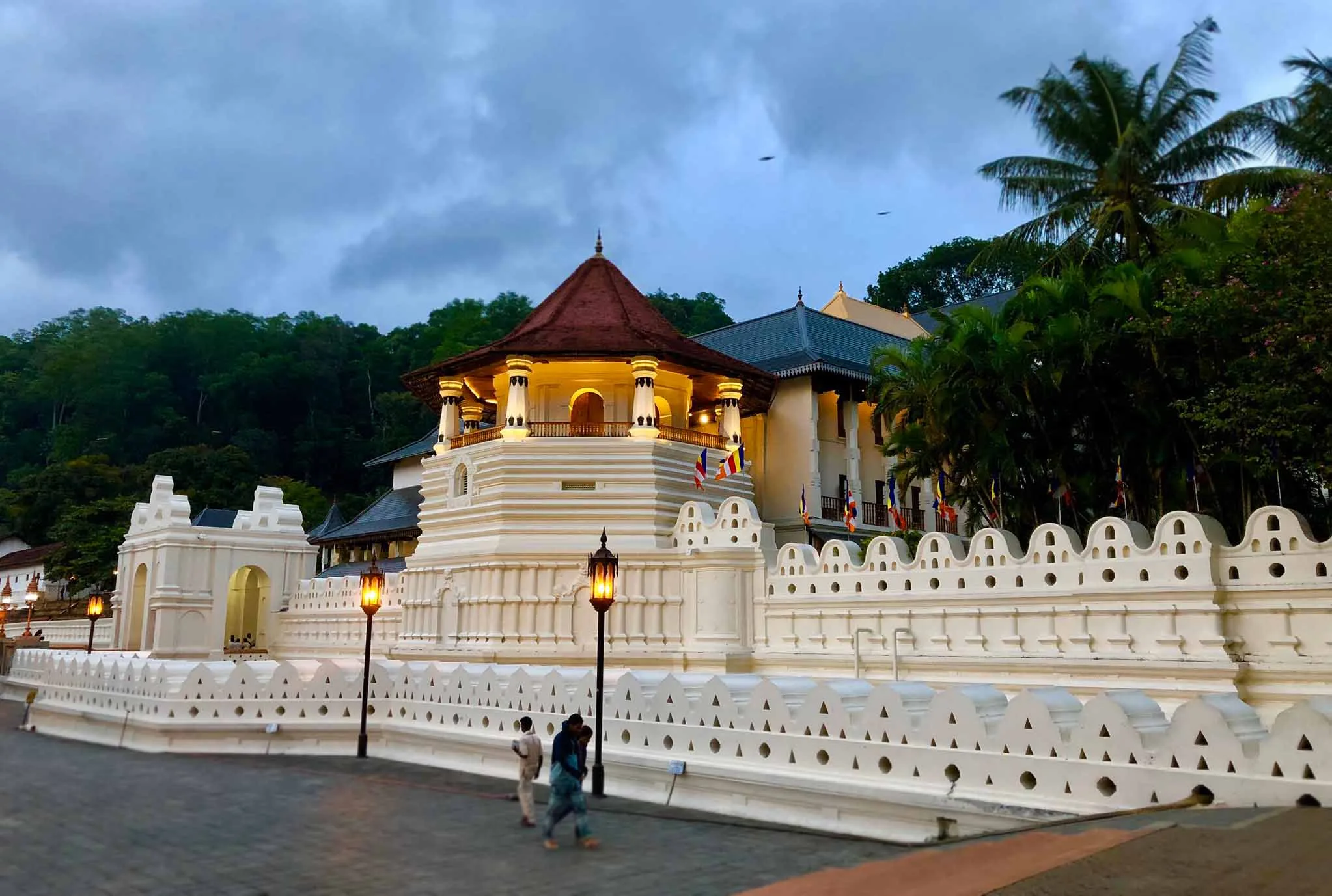 The historic octagonal pavilion (Paththirippuwa) and decorative cloud wall of the Temple of the Sacred Tooth Relic (Sri Dalada Maligawa) in Kandy.
Iconic Landmarks and Places to Visit
Kandy Lake (Kiri Muhuda)
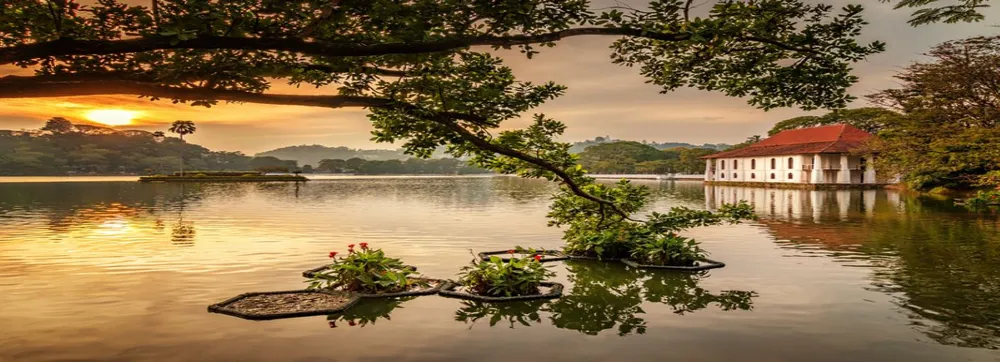
Gracefully situated in the center of the city, Kandy Lake—historically named Kiri Muhuda, or the “Sea of Milk”—was constructed in 1807 by King Sri Wickrama Rajasinha, the final monarch of Kandy. Spanning an expanse of roughly 3.2 kilometers in perimeter, the lake is flanked by a picturesque pathway shaded by giant tropical rain trees, flowering flamboyants, and weeping willows.
A stroll around the lakeshore offers serene views of the temple’s golden roof reflecting in the calm waters, alongside sightings of local cormorants, monitor lizards, and pelicans. In the center of the lake sits the small artificial island known as Diyathilaka Mandapaya, which once housed the king’s private summerhouse and royal pleasure pavilions.
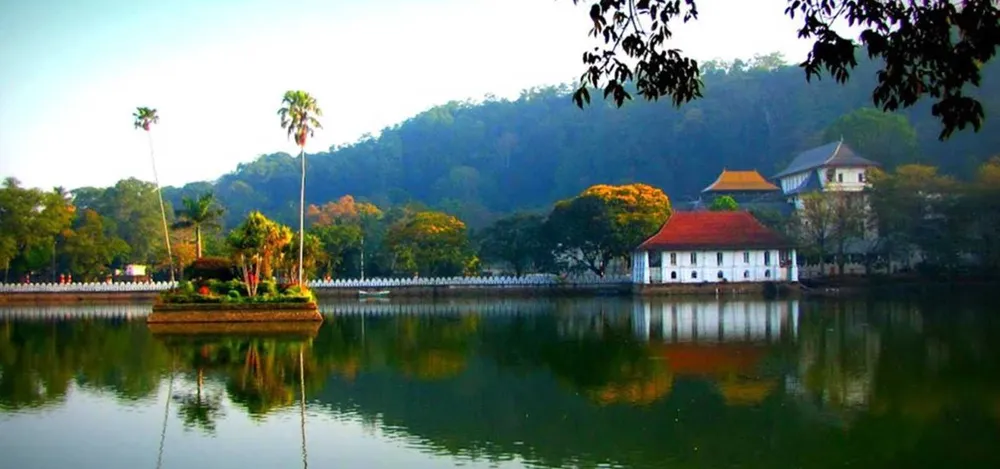 The tranquil waters of Kandy Lake (Kiri Muhuda), framed by forested hills and historic architecture.
Royal Botanic Gardens, Peradeniya
Located approximately 5.5 kilometers west of Kandy along a wide loop of the Mahaweli River, the Royal Botanic Gardens at Peradeniya is widely recognized as one of the finest botanical gardens in the world. Originally established in 1371 as a royal pleasure garden for King Wickramabahu III, the grounds were transformed into a formal scientific botanical garden by the British in 1821.
Covering 147 acres of lush terrain, the gardens house more than 4,000 distinct plant species. Highlights include the celebrated Orchid House, showcasing over 300 varieties of rare tropical orchids; the majestic Avenue of Royal Palms and Avenue of Cook’s Pines; the colossal Javan fig tree, whose sweeping surface roots cover an enormous lawn; and an extensive medicinal herb and spice arboretum featuring nutmeg, cinnamon, and clove trees.
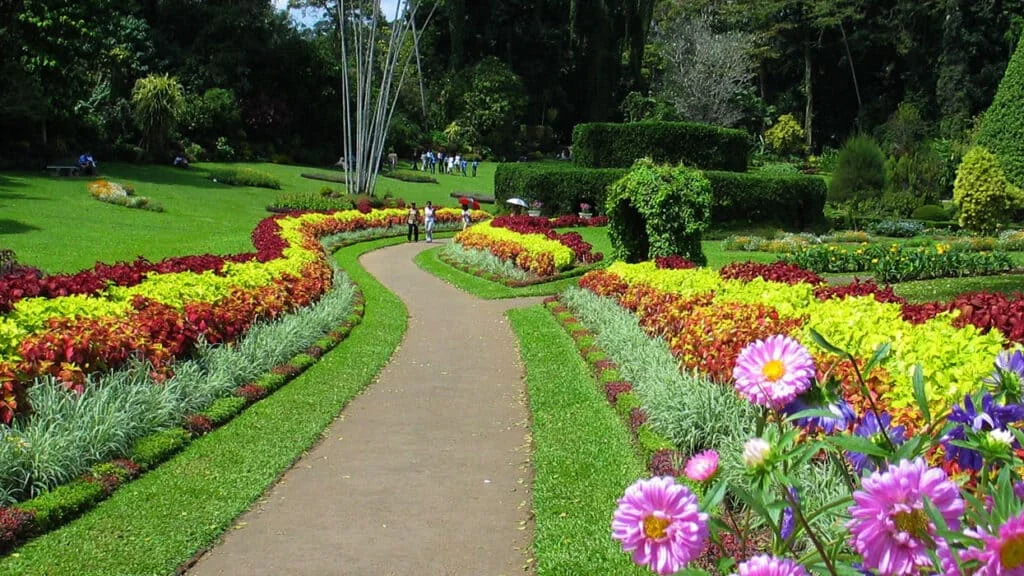 The meticulously manicured lawns and vibrant tropical flower borders of the Royal Botanic Gardens at Peradeniya.
Bahirawakanda Vihara Buddha Statue
Perched high upon the crest of Bahirawakanda hill overlooking the western rim of the city, the monumental Bahirawakanda Vihara is renowned for its colossal 88-foot (26.8-meter) seated white Buddha statue. Depicted in the meditative Dhyana Mudra posture, the statue is visible from nearly every corner of Kandy town.
Visitors can climb a flight of stairs behind the statue to reach elevated viewing balconies that reward climbers with 360-degree panoramas across Kandy Lake, the Temple of the Tooth, and the surrounding amphitheater of green mountains. The viewpoint is particularly enchanting at dusk when the evening lights of the city begin to twinkle below.
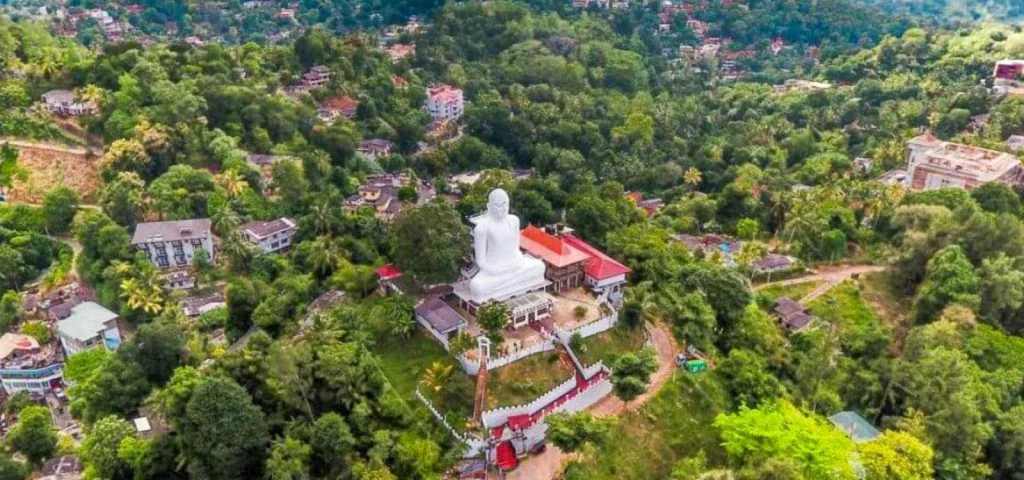 The colossal 88-foot seated Bahirawakanda Buddha statue overlooking the valley of Kandy.
Udawattakele Forest Sanctuary
Rising directly behind the Temple of the Sacred Tooth Relic lies the historic Udawattakele Forest Sanctuary, an ancient 257-acre tropical rainforest reserve. Known historically as Uda Wasala Watta (the garden above the royal palace), the forest once served as a private sanctuary for Kandyan royalty and an impenetrable defensive barrier against invaders.
Today, Udawattakele provides a tranquil walking haven characterized by dense jungle foliage, towering canopy trees entwined with giant lianas, and quiet gravel trails leading to ancient meditation hermitages and the historic Senkanda Cave. The reserve is a sanctuary for endemic birdlife, butterflies, toque macaques, and small mammals, offering a secluded retreat from the bustle of the city center.
Kandy Viewpoint (Arthur’s Seat)
Situated along Rajapihilla Mawatha high above the southern shore of Kandy Lake, the Kandy Viewpoint (historically referred to as Arthur’s Seat) provides the classic postcard vista of the city. From this vantage point, travelers can take in unobstructed sightlines encompassing the entire sweep of the lake, the octagonal tower of Dalada Maligawa, the white colonial facades of the Queen’s Hotel, and the forested slopes of the Knuckles Range stretching into the distance.
The Historic Three Temple Loop
For travelers interested in medieval religious art and architecture, a half-day excursion southwest of Kandy reveals the “Three Temple Loop,” comprising three fourteenth-century temples built during the Gampola kingdom:
Embekke Devalaya is celebrated for possessing the most masterfully executed wood carvings in the country. The open-sided drum hall (Digge) features thirty-two carved timber columns decorated with dynamic bas-reliefs depicting mythical creatures like the double-headed eagle (Bherunda Pakshaya), fighting soldiers, acrobats, and delicate floral motifs.
Lankatilaka Vihara stands dramatically atop the uneven surface of Panhalgala rock. Constructed primarily of solid brickwork and granite, the temple showcases a distinctive multi-story design that harmoniously combines a Buddhist image hall with shrines dedicated to guardian Hindu deities.
Gadaladeniya Vihara, built almost entirely of carved granite stone blocks, demonstrates heavy South Indian Vijayanagara architectural influences, featuring ornate stone doorways, carved pillar capitals, and a seated Buddha statue framed by an intricately sculpted dragon arch (Makara Torana).
Cultural Traditions, Dance, and Festivals
Traditional Kandyan Dance Performances
The performing arts of Kandy (Uda Rata Natum) represent one of the purest surviving forms of classical indigenous dance. Daily evening cultural performances held near the lake showcase the extraordinary athleticism, elaborate costumes, and rhythmic complexity of Kandyan tradition.
Dancers perform in resplendent ceremonial attire featuring polished silver headdresses (Ves tattuwa), breastplates composed of hundreds of glass beads, and brass armlets. The performances encompass energetic harvest dances, masked folk theater, acrobatic flips, and rhythmic drum competitions played on the double-ended Geta Beraya. The spectacle typically culminates in a thrilling display of fire manipulation, including fire breathing and bare-foot walking across red-hot wood coals (Gini Sisila).
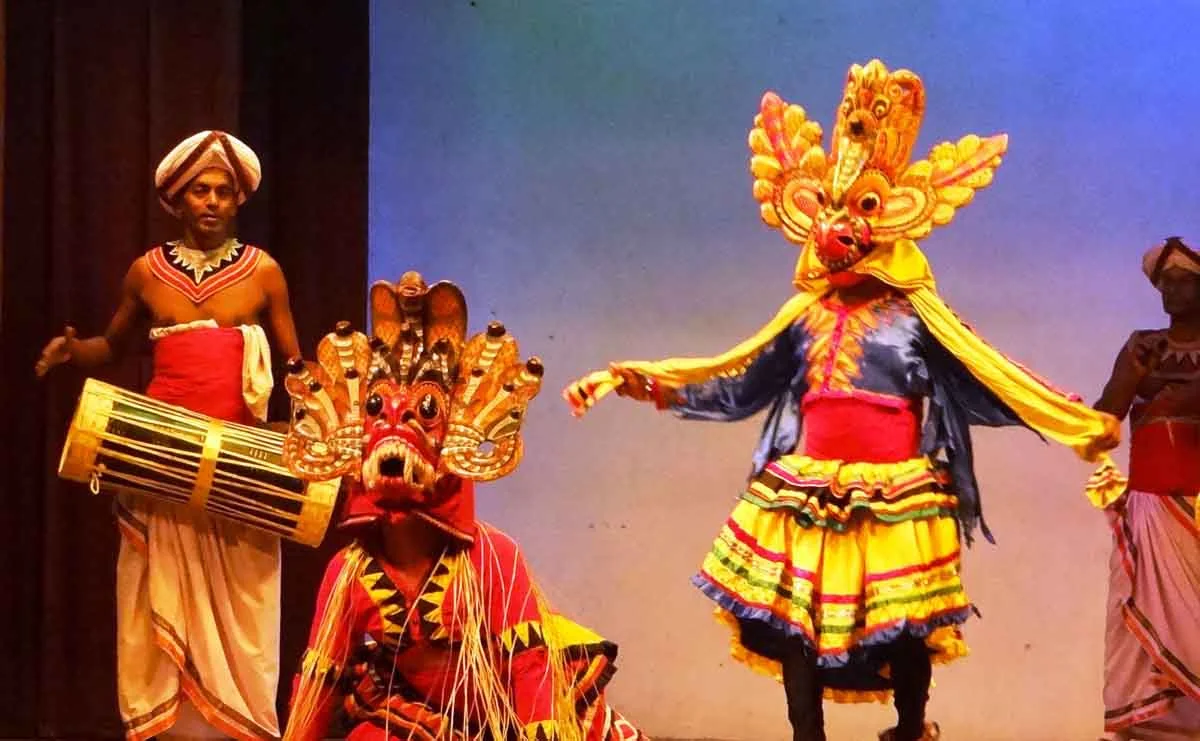 Traditional Kandyan dancers and drummers performing dynamic masked dances in full ceremonial regalia.
The Grand Kandy Esala Perahera
Each year during the lunar month of Esala (falling in July or August), Kandy hosts the Esala Perahera, widely regarded as one of the most spectacular religious pageants in Asia. Spanning ten consecutive nights of escalating grandeur, the festival honors the Sacred Tooth Relic and seeks blessings for abundant monsoon rains and agricultural prosperity.
The final procession (Randoli Perahera) features more than a hundred magnificent tuskers draped in opulent velvet garments embroidered with gold and illuminated by thousands of twinkling electric lights. Leading the procession, the monumental Maligawa Tusker carries a replica of the sacred casket through streets lined with tens of thousands of pilgrims. The elephant procession is accompanied by crackling whip-performers, acrobatic fire spinners, brass bands, and over a thousand Kandyan dancers and drummers performing in devotional harmony.
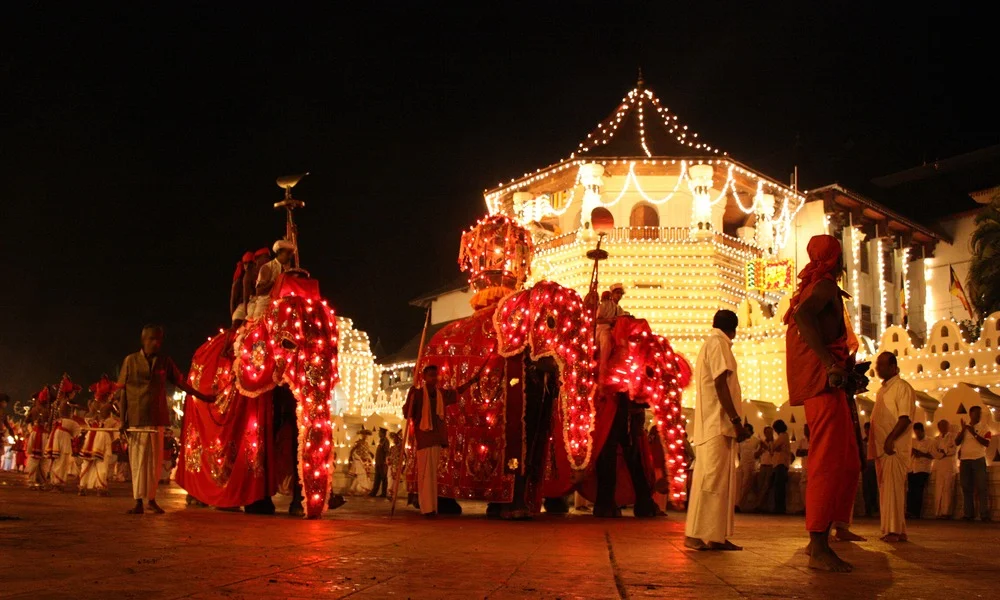 The Grand Kandy Esala Perahera, featuring illuminated caparisoned tuskers and traditional dancers before the Temple of the Tooth.
Nature, Trekking, and Scenic Rail Journeys
Kandy serves as the principal gateway for exploring the dramatic wilderness of the central highlands. Avid trekkers can venture into the Hanthana Mountain Range for rewarding day hikes across high tea country ridges, or undertake guided multi-day expeditions into the rugged UNESCO-inscribed Knuckles Mountain Range, celebrated for its cloud forests, cascading mountain streams, and rare endemic species.
Kandy is also the world-renowned starting point for the legendary scenic train ride to Ella. Departing from Kandy Railway Station, the train climbs steadily through highland passes, weaving past deep gorges, thundering waterfalls, and endless tea estates on its journey toward Nuwara Eliya and Ella.
Best Time to Visit Kandy
Kandy enjoys pleasant temperatures year-round, but specific seasons offer distinct advantages for travelers.
The primary dry season spans from December to April, bringing sunny days, comfortable humidity levels, and clear mountain vistas that are ideal for sightseeing, hiking, and exploring botanical gardens.
The months of July and August represent the cultural zenith of the year due to the Esala Perahera festival. While city hotels and viewing seats must be reserved months in advance, witnessing the historic pageant is an unforgettable travel experience.
The inter-monsoonal periods from May to June and October to November bring afternoon rainfall and mystical valley mist. While outdoor trails can be damp, the rains revitalize the surrounding countryside, leaving the hills extraordinarily green and the waterfalls full.
Planning Your Journey with Overa Tours
Kandy seamlessly bridges the ancient heritage of the Cultural Triangle—including Sigiriya Rock Fortress and Dambulla Cave Temple—with the alpine tea country of Nuwara Eliya and Ella.
Our curated itineraries provide dedicated private transport, licensed chauffeur-guides, confirmed reservations for cultural dance performances and temple tours, and handpicked boutique accommodations across the highland valleys. To plan your personalized tour of Kandy, contact our travel specialists.
Frequently Asked Questions
What is the dress code for visiting the Temple of the Sacred Tooth Relic?
Because the Temple of the Sacred Tooth Relic is the most sacred Buddhist sanctuary on the island, strict modesty guidelines apply. Visitors must wear clothing that covers both shoulders and knees. White or light-colored attire is customary and preferred. Footwear and hats must be removed before entering the inner temple precinct; a secure shoe deposit counter is available near the main entrance for a nominal fee.
When are the daily puja offering ceremonies held at Sri Dalada Maligawa?
The temple conducts three daily puja (worship) services: the morning service at approximately 5:30 AM, the midday service at 9:30 AM, and the evening service at 6:30 PM. During these services, ceremonial drums and flutes are sounded, and the doors of the inner chamber containing the golden relic caskets are opened for devotees to present their offerings of fresh flowers.
How much time should I allocate to explore Kandy?
Most travelers find that spending two to three full days allows ample time to visit the Temple of the Sacred Tooth Relic, stroll along Kandy Lake, explore the Royal Botanic Gardens at Peradeniya, attend an evening Kandyan dance show, and embark on day excursions to the Three Temple Loop or the Hanthana tea hills.
When does the Kandy Esala Perahera take place, and should I book in advance?
The Kandy Esala Perahera occurs annually during the full moon period of July or August. Because hundreds of thousands of local pilgrims and international visitors attend the ten-day festival, hotel accommodations and grandstand viewing seats along the procession route should be reserved several months in advance.
What is the best way to get around Kandy and its surroundings?
The central attractions around Kandy Lake and the Temple of the Tooth are easily explored on foot. For visits to the Royal Botanic Gardens at Peradeniya, Bahirawakanda Vihara, or the Three Temple Loop, traveling with a private chauffeur-guide or local metered three-wheeler provides a convenient and flexible way to navigate the hilly terrain.
Can Kandy be visited as a day trip from Colombo?
While a day trip from Colombo is possible via the central expressway or express train (taking roughly three hours each way), an overnight stay of at least one or two nights is strongly recommended to experience evening pooja ceremonies at the Temple of the Tooth and enjoy the city's tranquil mountain atmosphere without feeling rushed.