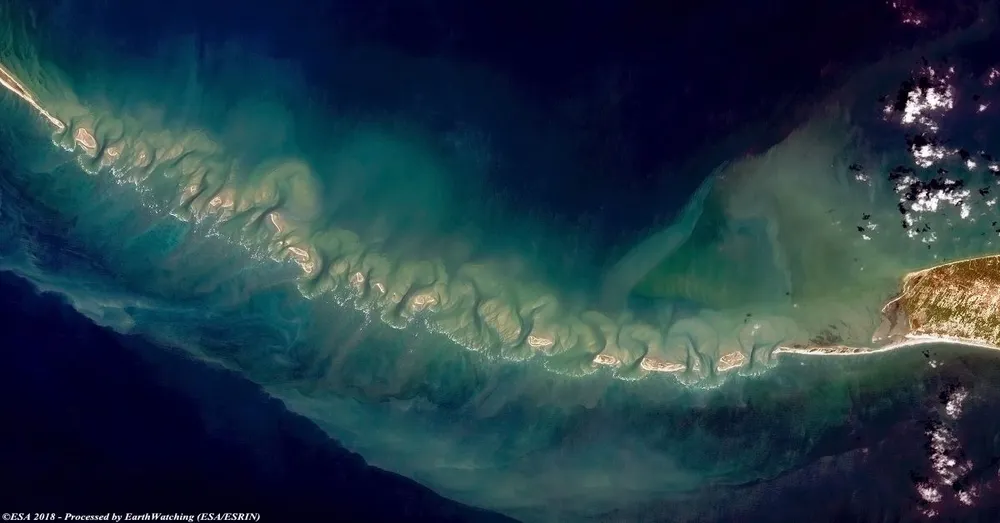
Stretching 48 kilometers across the shallow, turquoise waters of the Palk Strait, Ram Setu Bridge (also known as Adam’s Bridge) is an extraordinary chain of natural limestone shoals, coral reefs, and low sandbanks. Linking the western tip of Mannar Island in the northwest with Rameswaram Island in Tamil Nadu, India, this geological wonder has captivated historians, spiritual pilgrims, and oceanographers for millennia.
Historical records preserved in the temple archives of Rameswaram state that the causeway was entirely above sea level and passable on foot until a powerful cyclone breached the sandbars in 1480 CE. Today, the water depth across much of the reef rarely exceeds one to two meters, creating a natural maritime barrier that prevents deep-draft ocean vessels from navigating directly between the Gulf of Mannar and the Palk Strait.
Ramayana Tradition & The Engineering of Nala
In the ancient Sanskrit epic Ramayana, authored by the sage Valmiki, Ram Setu holds a central role in the climax of the narrative:
- The Vanara Causeway: After Princess Sita was abducted to the island by King Ravana, Lord Rama assembled an army of Vanaras (monkey warriors) to build a causeway across the ocean.
- Nala’s Architecture: The construction was supervised by the divine architect Nala, leading the structure to be historically referenced as Nala Setu.
- Floating Stones: According to Hindu devotional tradition, the stones used to build the bridge floated upon the water once inscribed with the sacred name of Rama, enabling the army to march across the ocean to victory.
Islamic Lore & The Adam’s Bridge Moniker
The name “Adam’s Bridge” gained prominence through early Arab cartographers and British colonial surveyors:
- The First Man’s Crossing: Islamic traditions suggest that following Adam’s expulsion from Paradise, he crossed these shallow sandbanks into exile, journeying southward toward the sacred summit of Adams Peak (Sri Pada).
- Colonial Navigation: Early British navigational charts officially adopted the designation “Adam’s Bridge,” documenting 16 distinct sandbar islands exposed during low tide.
Adam’s Bridge Marine National Park & Avifauna
Recognizing the unique ecological value of the marine corridor, the territorial waters surrounding the sandbanks were gazetted in 2015 as the Adam’s Bridge Marine National Park:
- Migratory Bird Sanctuary: The exposed sand dunes serve as vital roosting and nesting havens for thousands of long-distance migratory shorebirds flying along the Central Asian Flyway, including greater flamingos, crab-plovers, Caspian terns, and bar-tailed godwits.
- Marine Life: The shallow seagrass meadows and fringing coral reefs sustain diverse marine species, including vulnerable dugongs (sea cows), green sea turtles, and rich fisheries.
Practical Visiting Information
- Access Point: Excursions to view the first sand islands typically depart from the fishing hamlet of Talaimannar at the western terminus of Mannar Island.
- Boat Safaris: Authorized local fishermen and naval authorities operate seasonal boat tours to the sandbar islands when weather and tidal conditions permit.
- Best Season to Visit: The dry, calm window between December and April provides the best ocean conditions, clear visibility, and peak migratory bird numbers.
Connected Ramayana & Regional Destinations
- Mannar Island Guide: Explore ancient baobab trees, Portuguese forts, and windswept beaches.
- Adams Peak (Sri Pada): The venerated mountain pilgrimage peak linked to ancient legends of Adam.
- Munneswaram Temple: The ancient Pancha Ishwaram in Chilaw where Lord Rama prayed for absolution.
- Manavari Temple: The sacred site where Rama installed the first Shiva Lingam.
- Koneswaram Temple: The clifftop Shiva shrine overlooking Trincomalee’s Swami Rock.
- Wilpattu National Park: Combine your northern journey with a wildlife safari in the country’s oldest national park.