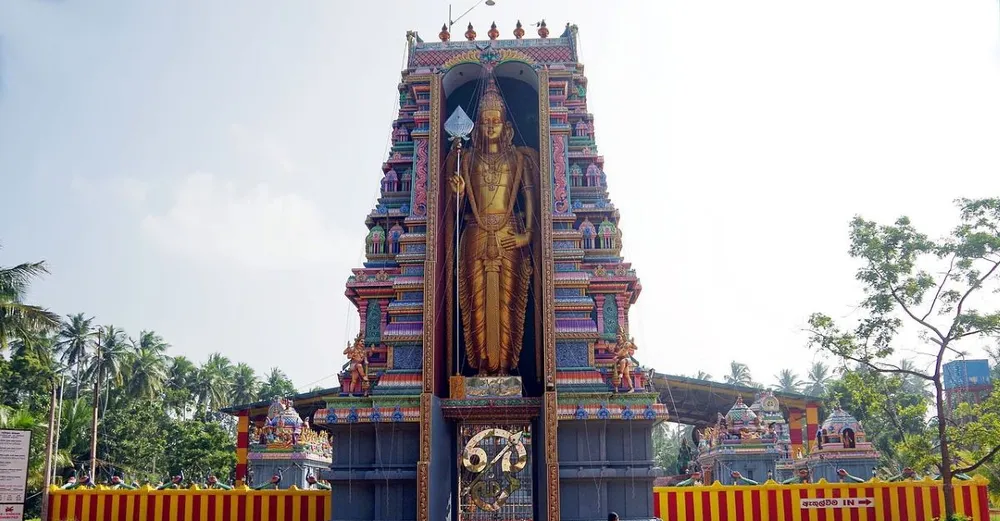
Munneswaram Temple, situated near the coastal town of Chilaw in the Puttalam District, is one of the most venerable and historically significant Hindu temple complexes on the island. Continuously sanctified since at least 1000 CE—with sacred traditions dating back far into antiquity—the sanctuary is celebrated as one of the five ancient Pancha Ishwarams dedicated to Lord Shiva, built to safeguard the coastal boundaries of the island.
The complex is comprised of five distinct shrines, with the central and most magnificent temple consecrated to Lord Shiva in the form of Sri Munnainathar (Lord of Antiquity). Surrounding sanctums honor Goddess Bhadrakali, Lord Ganesha, Lord Murugan, and the folk deity Ayyanar. Revered by both Hindu and Buddhist pilgrims, Munneswaram stands as a monumental symbol of shared spiritual heritage.
Historical Legacy & Reconstruction
Throughout the centuries, Munneswaram enjoyed the patronage of royal dynasties, including Chola monarchs and Sinhalese kings of the Kotte and Sitawaka kingdoms. During the Portuguese colonial occupation in the late 16th and early 17th centuries, the temple was sacked and dismantled twice: first in 1578, when only its massive stone foundation survived, and again in the early 1600s. King Rajasinghe I of Sitawaka oversaw its initial restoration, and local devotees rebuilt the magnificent Dravidian structures anew, preserving ancient inscriptions, bronze idols, and ceremonial traditions that flourish to this day.
In Ramayana Tradition & Ancient Myths
Munneswaram occupies a foundational position within the sacred Ramayana trail:
- Absolution of Lord Rama: Following the victory over King Ravana, Lord Rama felt plagued by Brahmahatya Dosham—the karmic sin of slaying a Brahmin scholar king. While flying northward in the Pushpaka Vimana, Rama felt a divine aura and stopped at Munneswaram to pray to Lord Shiva for forgiveness.
- Divine Instruction: Lord Shiva appeared before Rama and counseled him to install four consecrated Shiva Lingams across the island to purify his soul. The very first of these lingams was installed just 10 kilometers north at Manavari Temple, which Rama named the Ramalingam.
- The Chola King’s Healing: Tamil traditions recount that a Chola king suffering from a chronic skin ailment was miraculously cured after bathing in the temple’s sacred holy pond, prompting him to endow extensive lands and establish hereditary priestly lineages.
Annual Festivals & Sacred Pujas
Munneswaram is renowned for vibrant religious celebrations that draw hundreds of thousands of devotees:
- Munneswaram Mahotsavam: The principal temple festival spans four weeks in July and August, culminating in the grand chariot (Ther) procession and water-cutting ceremony (Theertham).
- Maha Shivaratri: An all-night vigil in February or March featuring four special abhishekam pujas dedicated to Lord Shiva.
- Navarathri Festival: A nine-night autumn festival celebrating the nine divine manifestations of the goddess Shakthi with ornate floral decorations and devotional music.
Visiting Details & Practical Information
- Location: Approximately 2 km east of Chilaw along the Chilaw–Wariyapola road in the North Western Province.
- Distance from Key Cities: Roughly 82 km north of Colombo (approx. 2 hours via the coastal road) and 50 km north of Negombo and Negombo Beach.
- Temple Hours: Open daily from 5:30 AM to 8:00 PM. Morning and evening pujas are held with traditional nadaswaram music and camphor flame rituals.
- Admission & Etiquette: Admission is free for all visitors. Devotees may purchase small offerings (fruits and flowers) for personal blessings. Modest attire covering shoulders and knees is mandatory; shoes must be removed before entering the courtyard.
Connected Ramayana Trail Shrines
Travelers and pilgrims tracing the epic circuit can connect Munneswaram with notable sacred sites across the island:
- Manavari Temple: The neighboring shrine where Lord Rama installed the first Shiva Lingam (Ramalingam).
- Koneswaram Temple: The clifftop Pancha Ishwaram at Swami Rock in Trincomalee.
- Kelaniya Temple: The historic site near Colombo where Vibhishana was anointed King of Lanka.
- Seetha Amman Temple: The colorful roadside shrine at Ashok Vatika in Nuwara Eliya.
- Divurumpola Temple: The sacred site in Welimada where Sita proved her devotion through the trial by fire.
- Dolukanda: The prominent herbal mountain ridge in Kurunegala associated with Lord Hanuman.
- Gayathri Peedam: The spiritual sanctuary in Nuwara Eliya where Indrajit performed yagnas.
- Seetha Kotuwa: The ancient jungle fortress ruins in Hasalaka.
- Wilpattu National Park: Combine your pilgrimage with a northern wilderness safari in Puttalam District.