Hidden deep within the dense subtropical rainforests of Gurulupotha in Hasalaka, along the eastern slopes descending from the central highlands toward Mahiyangana, Seetha Kotuwa (Sita’s Fort) is an atmospheric archaeological and legendary site on the Ramayana trail.
Translating in Sinhala to “Sita’s Fortress,” this secluded forest complex is intertwined with ancient epic lore, holding centuries-old stone ruins shrouded by wild jungle canopies and flowing streams.
Legend of Queen Mandodari’s Fortress Palace
According to local folklore and Ramayana traditions in the hill country:
- The Initial Sanctuary: Following Princess Sita’s abduction from India in the flying chariot Pushpaka Vimana, King Ravana initially brought her to this fortress retreat, which served as the palace residence of his chief queen, Mandodari.
- Mandodari’s Compassion: Queen Mandodari, celebrated for her virtue and righteousness, is said to have provided comfort and protection to Sita within this secluded jungle refuge before Sita was later relocated to Ashok Vatika at Seetha Amman Temple in Nuwara Eliya.
- Gurulupotha & Jatayu’s Battle: The adjacent village name, Gurulupotha, translates to “Parts of the Bird.” Local legend recounts that this was the terrain where the noble demi-god bird king Jatayu fell to earth after being mortally wounded while attempting to rescue Sita from Ravana’s airborne chariot.
Archaeological Ruins in the Jungle
Beyond its mythological resonance, Seetha Kotuwa contains an ancient Buddhist monastic and palace complex dating from the Anuradhapura and Polonnaruwa eras:
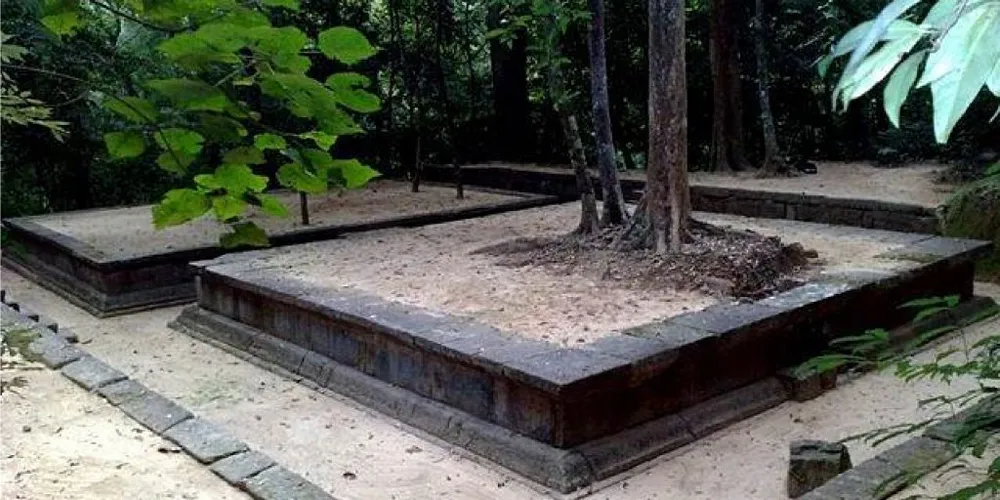
- Monastic Foundations: Archaeological excavations have revealed stepped brick stupa mounds, carved granite foundation slabs, and stone pillars scattered throughout the forest floor.
- Moonstones & Guardstones: Weathered moonstones (sandakada pahana) and carved balustrades (korawakgala) mark the entrances to ancient image houses.
- Ponds & Water Channels: Ancient stone-lined bathing ponds and sophisticated subterranean water conduits illustrate the architectural mastery of early monastic settlements nestled in the Knuckles foothills.
The Jungle Trail & Waterfall
Exploring Seetha Kotuwa combines historical discovery with a scenic nature trek:
- The Forest Trail: The ruins are reached via a gentle 1 km walking trail starting near the 18 Hairpin Bends (Daha Ata Wanguwa) highway corridor in Gurulupotha.
- Streams & Waterfalls: The path traverses lush canopy and clear streams, leading to the nearby Gurulupotha Waterfall which cascades down mossy limestone boulders into forest plunge pools.
- Birdlife & Ecology: The surrounding forest reserve is rich in highland biodiversity, including hornbills, endemic flycatchers, monitor lizards, and towering hardwood trees.
Practical Visitor Tips
- Location: Gurulupotha, near Hasalaka on the Kandy–Mahiyangana highway (approx. 65 km east of Kandy).
- Footwear & Trail Advice: Wear comfortable walking shoes suitable for dirt paths and damp stone steps; carry drinking water.
- Leech Caution: Wet weather brings leeches to the forest floor; wearing leech socks or applying citronella oil is recommended during the rainy season.
Connected Ramayana & Regional Destinations
- Seetha Amman Temple: The Ashok Vatika temple in Nuwara Eliya where Sita was subsequently sheltered.
- Divurumpola Temple: The historic site of Sita’s trial by fire in Welimada.
- Ravana Cave & Ravana Falls: The cliffside cavern hideout and tiered waterfall in Ella.
- Meemure Ancient Village: The isolated Knuckles village nestled beneath Lakegala peak.
- Kandy Hill Capital: The cultural capital situated on the western approach across the mountain pass.
- Riverston Peak: Scenic highland ridge trekking and Mini World’s End in the northern Knuckles range.